Skip to content
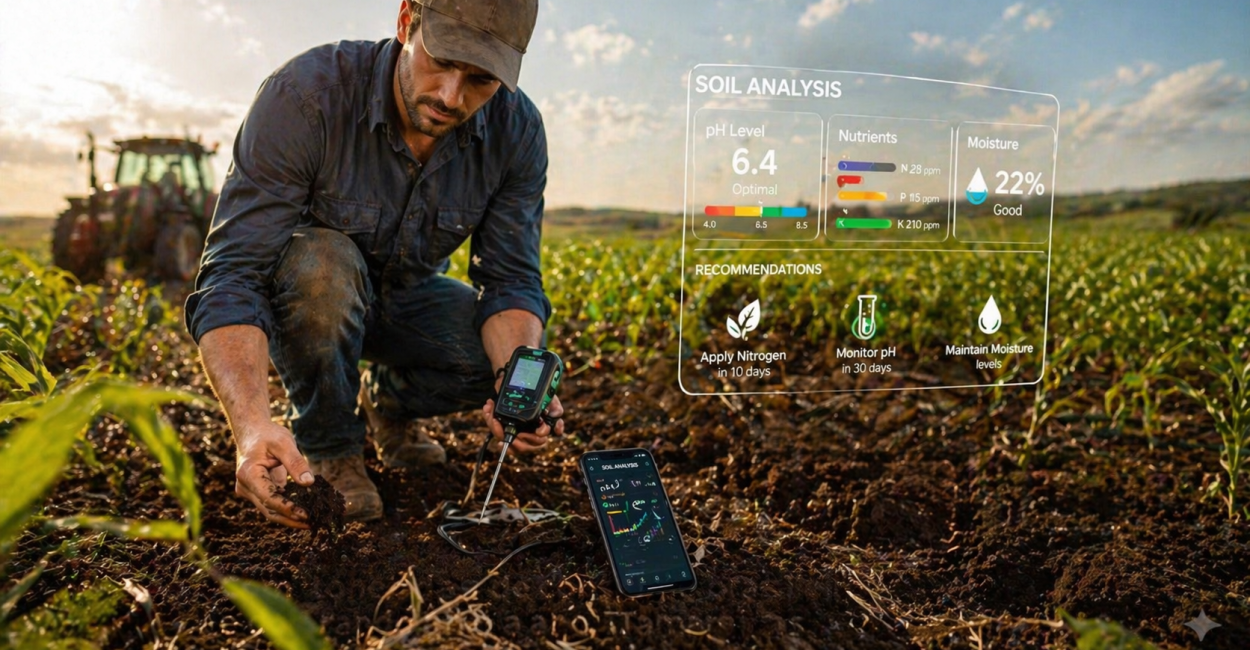
Farming success starts below ground: understanding soil health is the fastest way to improve yields and cut waste. The best soil testing kits for farmers 2026 help you measure pH, nutrients, and moisture so you can apply the right inputs at the right time.
Imagine spending thousands on fertilizer with little return — many producers do, because roughly 75% of soils worldwide have pH imbalances that block nutrient uptake. A simple soil test can reveal problems and unlock productivity. Keep reading to find the exact soil testing kit that matches your farm size, budget and crop type.
Why Choose the Best Soil Testing Kits for Farmers 2026
Immediate Value of On-farm Soil Testing
Testing soil on-site offers immediate, actionable data for pH, moisture and basic fertility. Farmers can spot acidity, alkalinity, or drought stress quickly and avoid blanket fertilizer applications that waste money. Using a reliable soil test kit reduces guesswork and makes nutrient management evidence-based.
Right tools streamline decisions during planting, fertilization and irrigation. Even simple digital probes or test strips can guide lime or sulfur applications, saving inputs and protecting yield.
As the market offers better handheld sensors, the best soil testing kits for farmers 2026 deliver faster returns and easier field management.
Economic Impact and ROI
Every dollar spent on accurate soil testing can save multiples in avoided fertilizer and improved yields. Studies and extension services often cite ROI ratios where $1 in testing can prevent $8–$10 in unnecessary inputs. For commercial growers, that adds up quickly to thousands in savings per season.
Targeted nutrient applications based on test results reduce costs and environmental losses from runoff, improving both the bottom line and regulatory compliance. The economic case for buying a quality kit is strong for farms of all sizes.
Choosing the right type of kit—mail-in lab for deep analysis or digital probes for routine checks—affects ROI timeline and precision.
What Modern Kits Reveal
Top soil testing solutions in 2026 can measure pH, macronutrients (N, P, K), micronutrients, moisture, temperature and microbial activity. Some combine lab-grade accuracy with smartphone connectivity for trend tracking. Farmers gain a multidimensional view of soil fertility, structure and health.
Interpreting these metrics lets growers match fertilizer blends to crop needs, apply lime precisely, and time nutrient applications for peak uptake. That reduces waste and increases crop quality.
Using the best soil testing kits for farmers 2026 means actionable insights rather than guesswork—backed by clear recommendations and sometimes agronomic support.
Types of Best Soil Testing Kits for Farmers 2026: Choose What Fits Your Operation
DIY Chemical Kits: Quick, Cheap and Practical
- Low-cost testing for pH and basic N-P-K indicators
- Fast results in minutes—good for routine checks
- Handy for small plots, greenhouses and beginner farmers
- Ideal as a first-line monitoring tool between lab tests
DIY chemical test kits provide a low barrier to entry for soil monitoring. They use reagents or colorimetric strips to indicate pH and coarse nutrient levels and are best used for routine checks rather than definitive recommendations.
Because they give quick feedback, you can test multiple spots in a single field and detect hot spots of deficiency or acidity before committing to expensive inputs. They work well alongside occasional lab tests for comprehensive planning.
Mail-in Laboratory Kits: Deep Analysis and Tailored Recommendations
Mail-in kits involve collecting representative samples and sending them to a certified lab for multi-nutrient analysis. Results typically arrive in 6–8 days and include pH, macronutrients, micronutrients and fertilizer recommendations tailored to crop type.
These tests are the gold standard for pre-plant planning, crop rotation shifts or diagnosing persistent yield issues. For large acreage or high-value crops, a mail-in test’s precision justifies the time and cost.
Consider services from universities or reputable companies for dofollow, science-based guidance; results often include lime and fertilizer prescriptions you can act on immediately.
Digital & Smart Soil Testers: Continuous Monitoring and Data Logging
Smart testers use inserted probes or wireless sensors to read pH, moisture, temperature and sometimes electrical conductivity. Readings appear instantly on displays or via smartphone apps, enabling trend monitoring across the season.
They are ideal for precision agriculture, greenhouse management and irrigation scheduling. Many integrate with farm software to visualize spatial variability and schedule interventions.
While not a full replacement for lab nutrient assays, digital testers excel at ongoing field monitoring and quick corrective actions, making them a key part of a modern toolkit.
| Kit Type | Best Use |
|---|---|
| DIY Chemical | Routine checks, low cost |
| Mail-In Lab | Pre-plant planning, deep analysis |
| Digital/Smart | Continuous monitoring, precision |

How to Pick the Best Soil Testing Kits for Farmers 2026 For Your Farm
Assess Farm Size, Crop Value and Testing Frequency
- Small plots: affordable DIY kits or pH strips
- Medium farms: digital probes for routine checks
- Large or high-value crops: mail-in laboratory analysis
- Mixed operations: hybrid approach—lab tests plus field sensors
- Greenhouses: continuous digital monitoring preferred
Start by matching kit capability to your operation scale and crop economics. High-value crops or expensive inputs justify higher-cost, more precise testing. For commodity grains, periodic lab tests combined with in-season probe checks are efficient.
Also factor in labor to collect samples and interpret results—kits with clear recommendations or agronomic support reduce time and decision risk.
Evaluate Accuracy, Parameters and Ease of Use
Accuracy matters: lab tests remain the benchmark for nutrient quantification, while digital meters are improving for pH and moisture. Check parameter lists—does the kit measure N, P, K, calcium, magnesium or micronutrients you care about?
User-friendliness impacts adoption: color charts, digital readouts and smartphone interpretation tools help farm teams make fast, correct decisions. Durability for field conditions is essential for handheld sensors.
Consider calibration needs and consumable costs; a cheap initial buy may carry recurring reagent costs that add up over seasons.
Check Support, Reporting and Agronomic Guidance
Some mail-in services and premium kits include personalized recommendations or access to agronomists. That support is valuable when interpreting complex results or when planning major crop changes. Look for kits that clearly explain corrective actions—how much lime, which fertilizer blend, and timing.
Integration with extension services or university labs often brings trusted, region-specific advice. Also check if the vendor provides online dashboards or CSV exports for farm records.
Choosing a kit with solid reporting can turn raw numbers into profit-driving plans.
Top 7 Best Soil Testing Kits for Farmers 2026
Luster Leaf Rapitest 1602 — Best Overall for Beginners
What it tests and how it works: Measures pH and basic N-P-K via colorimetric chemical vials, with 20 tests included and a plant reference guide. Simple sampling and reagent mixing produce a color match to interpret values.
Time to result: ~10 minutes. Pros: inexpensive, easy to use, quick results, manufactured in the USA and top-rated on retail platforms. Cons: limited accuracy vs lab tests and no micronutrient analysis.
Price & ideal user: Around $17; ideal for beginner farmers and routine monitoring.
MySoil Soil Test Kit — Best for Complete Nutrient Analysis
What it tests and how it works: Mail-in laboratory kit that measures 13+ nutrients plus pH, with crop-specific recommendations returned by lab analysts. Instructions guide representative sampling for accurate, farm-scale results.
Time to result: 6–8 days. Pros: comprehensive nutrient profiling, actionable recommendations, high user ratings. Cons: slower turnaround and higher cost per test than DIY kits.
Price & ideal user: Around $27; ideal for producers needing pre-plant, deep analysis.
SONKIR MS02 3-in-1 Soil Meter — Best for Quick Field Monitoring
What it tests and how it works: Handheld probe reads pH, moisture and light instantly via analog display—no batteries required. Insert probe and read values on the dial for immediate field decisions.
Time to result: Immediate. Pros: compact, no recurring cost, portable for daily checks. Cons: does not measure NPK and less precise for professional fertilizer planning.
Price & ideal user: About $15; ideal for daily spot checks and growers needing instant feedback.
| Kit | Best For |
|---|---|
| Luster Leaf 1602 | Beginners |
| MySoil | Complete analysis |
| SONKIR MS02 | Field monitoring |
Whitetail Institute Laboratory Soil Test Kit — Best for Crop-specific Recommendations
What it tests and how it works: Mail-in test focused on P, K, Ca, Mg and pH, with agronomic consultation and culture-specific instructions. Sampling kits and shipping instructions simplify the process for growers.
Time to result: ~1 week. Pros: tailored recommendations from specialists; good when switching crop types. Cons: fewer nutrients tested than more comprehensive labs and higher cost.
Price & ideal user: Around $35; ideal for growers with crop-specific nutrient strategies or those seeking expert guidance.
Luster Leaf 1605 Digital Soil Test Kit — Best Digital Upgrade from Basic Kits
What it tests and how it works: A digital variant of the Luster Leaf line offering pH and NPK measurements with an LCD display for clearer readings. Uses chemical reagents like the analog kit but reports digitally.
Time to result: 10 minutes. Pros: easier-to-read digital output, improved precision over color charts. Cons: requires batteries and still lacks micronutrient testing.
Price & ideal user: About $25; ideal for producers wanting clearer results without lab costs.
Garden Tutor Soil PH Test Kit — Best for Frequent PH Monitoring
What it tests and how it works: pH-only kit with 100 test strips and optional web-based AI interpretation tools. Extremely low per-test cost makes it practical for repeated season-long checks.
Time to result: Seconds. Pros: cheapest on the list per test, lots of strips included, AI help for interpretation. Cons: limited solely to pH—no NPK or micronutrient data.
Price & ideal user: Around $12; ideal for growers who monitor pH frequently during the season or for greenhouse operators.
HSLGOVE 7-in-1 Soil Test Kit — Best for Maximum Parameter Coverage
What it tests and how it works: Digital probe measures pH, moisture, temperature, light and general fertility markers with dual-screen readout and no battery requirement. Great for multi-parameter spot checks across fields.
Time to result: Instant. Pros: broad parameter coverage in one tool, good value, instant readings. Cons: not a substitute for laboratory micronutrient assays when precise fertility prescriptions are required.
Price & ideal user: About $30; ideal for growers wanting wide coverage in a single handheld device for routine monitoring.

Comparison of the Best Soil Testing Kits for Farmers 2026 At a Glance
Quick Comparison by Use Case
Choosing among the best soil testing kits for farmers 2026 depends on whether you need instant field readings, deep lab analysis, or continuous monitoring. For starters, Luster Leaf 1602 is the most accessible. For full nutrient profiles, choose MySoil. For daily checks, SONKIR serves well.
Consider consumable costs, turnaround time and whether agronomic guidance is included. Combining kits—for example, lab tests once per year plus digital probes for in-season checks—often gives the best value and precision.
External resources like university extension pages provide regional guidance on interpreting numbers; see Penn State Extension and USDA for authoritative advice.
Technical Trade-offs and Purchasing Tips
Balance accuracy, speed and cost: mail-in labs are most accurate for nutrient quantification; digital meters excel at pH and moisture monitoring; DIY kits are cheapest for multiple spot checks. When buying, verify calibration procedures, warranty and consumable availability.
Check reviews and ask for sample reports from labs to ensure the format and recommendations match your decision-making needs. For larger farms, consider devices compatible with farm management software to log trends and correlate with yield maps.
Buying multiple kit types for different roles on the farm provides a layered approach to soil health management.
Implementation Strategy
Start with a baseline lab test before major field changes, then deploy digital meters for in-season monitoring and periodic DIY checks for quick verification. Document results and actions in farm records to evaluate ROI and refine timing for lime, fertilizer or organic amendments.
Training for field staff on correct sampling technique is crucial to get representative results. Poor sampling yields misleading results regardless of kit accuracy.
Adopt a testing cadence—pre-plant lab test, mid-season probe checks, post-harvest wing checks—to build a data-driven fertility program.
How to Test Your Soil: Step-by-step Using the Best Soil Testing Kits for Farmers 2026
Step 1–2: Sample Collection and Preparation
Collect multiple cores from representative spots across the field, avoiding fence lines, manure piles and odd patches. Combine samples from 10–20 points per management zone into one composite for testing. This mixing yields a representative sample of that zone.
Use a clean shovel or soil probe; place the combined sample on a clean tarp and air-dry if sending to a lab. Label samples clearly with field ID and crop to get tailored recommendations back from the lab.
Consistent sampling methodology is the foundation for reliable results—poor sampling can render even lab-grade analysis useless.
Step 3–4: Performing the Test and Reading Results
Follow kit instructions precisely: measure exact sample amounts, use the provided reagent volumes, and adhere to reaction times when using chemical kits. For digital probes, insert to the correct depth and avoid recently fertilized or wet spots that can skew readings.
Interpret results using the kit’s chart or the lab report’s interpretation guide. Pay attention to pH first—many nutrient issues are pH-driven. For mail-in kits, review the lab’s fertilizer and lime recommendations carefully and ask questions if something is unclear.
Record raw numbers and recommended actions; these values form the basis of your nutrient management plan for the season.
Step 5–6: Acting on Results and Repeat Testing
Take corrective action as indicated: apply lime for low pH or sulfur for high pH, choose fertilizer blends to address N-P-K gaps, and incorporate micronutrient amendments if deficiencies are reported. Time applications for crop uptake windows to maximize efficiency.
Repeat tests each season or when changing crops to monitor trends and verify that corrective measures had the desired effect. Use digital testers during the season to catch transient issues early.
A disciplined test-and-act routine turns soil data into improved yields and lower input costs over time.
Understanding Results from the Best Soil Testing Kits for Farmers 2026
Interpreting PH and Crop-specific Ranges
pH controls nutrient availability: most row crops prefer pH 6.0–7.0, vegetables often 6.0–6.8, blueberries and other ericaceous crops want acidic soils (4.5–5.5), while some forage and pasture species tolerate slightly higher pH. Use crop-specific tables to set lime targets and avoid blanket applications that may harm specialty crops.
If pH is off, correct gradually—apply lime based on lab recommendations and retest after several months to a year to gauge response. Over-liming can be as problematic as under-liming for some crops.
Integrate pH targets into your nutrient plan so fertilizers are effective and cost-efficient.
What Nitrogen (N), Phosphorus (P) and Potassium (K) Numbers Mean
Nitrogen drives vegetative growth; low N shows as chlorosis and stunting. Address N shortages with sidedress applications timed to peak uptake. Excess N can reduce quality and increase disease risk, so follow recommended rates.
Phosphorus supports root development and flowering; low P leads to weak rooting and poor establishment. Banding P close to the seed or starter applications can be effective for young crops, guided by lab recommendations.
Potassium enhances stress tolerance and fruit quality. Low K shows as marginal burn and poor disease resistance. Address deficits with broadcast or foliar applications as advised by your lab or agronomist.
Micronutrients, Organic Matter and Biological Indicators
Micronutrients like zinc, boron and manganese may be critical in some soils despite adequate macronutrients. Lab tests identify these needs; foliar sprays or soil-applied chelated forms correct deficiencies relatively quickly.
Soil organic matter and biological activity metrics are increasingly available and are key indicators of long-term soil health. Practices like cover cropping and reduced tillage improve these measures over time.
When results show complex or multiple deficiencies, consult an agronomist or extension specialist for integrated corrective strategies.
Home Kits Vs. Professional Lab Testing: Which of the Best Soil Testing Kits for Farmers 2026 To Use and When
When Home Kits Are Sufficient
Home kits (DIY chemical or basic digital probes) are perfect for routine monitoring, quick spot checks, and small-scale vegetable or hobby farms. They offer fast feedback for pH and moisture and help time simple corrective actions like lime top-ups.
Use them between annual lab tests to track trends and confirm that interventions worked. For many growers, a weekly or monthly routine using a handheld meter or pH strips catches problems early.
However, home kits have limitations in nutrient specificity and micronutrient detection.
When to Choose Professional Lab Analysis
Choose professional lab testing before planting high-value crops, when changing crop types, or when yields underperform despite inputs. Labs quantify NPK and micronutrients accurately and provide lime and fertilizer prescriptions adjusted for soil buffering capacity and crop needs.
Professional analysis is also recommended when soil contamination, salinity, or persistent disease issues are suspected—labs can run specialized tests that field kits cannot.
Combining lab data with farm records and yield maps enables strategic, profitable fertility planning across seasons.
Combining Approaches for Best Results
The optimal strategy is integrated: perform a comprehensive mail-in lab test annually or pre-plant, use digital or DIY kits for frequent in-season checks, and retain lab sampling for problem zones. This hybrid model balances accuracy, speed and cost-effectiveness.
Leverage extension programs or university labs for subsidized tests if available; many regions offer low-cost soil testing for farmers through cooperative extension services (Extension resources).
Document actions and test results in farm management software to track improvements and refine nutrient strategies year-to-year.
Conclusion
There is a right soil testing kit for every farm: from the affordable Luster Leaf Rapitest 1602 for beginners to the MySoil mail-in service for comprehensive nutrient analysis. Using the best soil testing kits for farmers 2026 lets you diagnose pH and nutrient issues, apply inputs precisely and increase ROI.
Final recommendations: beginner with limited budget → Luster Leaf Rapitest 1602; full pre-plant analysis → MySoil Kit; daily field monitoring → SONKIR MS02. Which soil testing kit are you using on your farm? Share your experience in the comments — we’d love to hear from you.
What is the Most Accurate Type of Soil Test for Nutrient Management?
The most accurate tests are mail-in laboratory analyses, which quantify macronutrients and micronutrients and provide lime and fertilizer recommendations. Labs use standardized methods to measure soil buffering and extractable nutrients, making them the preferred choice for pre-plant planning and when switching crops.
How Often Should a Farmer Test Their Soil Using the Best Soil Testing Kits for Farmers 2026?
Test at least once per year for typical crop rotations; pre-plant testing is recommended. Add in-season spot checks with digital probes and post-harvest tests to monitor change. High-value or intensively managed fields may benefit from more frequent sampling and monitoring.
Can a DIY Kit Replace Professional Lab Testing on a Commercial Farm?
DIY kits are useful for routine monitoring but do not replace lab testing for precise nutrient prescriptions. Commercial farms should use lab analysis for planning and rely on DIY or digital tools for in-season checks and quick decisions between lab cycles.
Are Digital Soil Testers Reliable Enough for Making Fertilizer Decisions?
Digital testers provide reliable pH and moisture data and are excellent for trend monitoring. However, for precise N-P-K and micronutrient management, pair digital readings with periodic lab tests to ensure accurate fertilizer recommendations and avoid costly mistakes.
Where Can I Send Samples for Professional Soil Testing and Advice?
Many universities, agricultural extension services and private labs accept samples and provide detailed reports with crop-specific recommendations. Check regional extension offices for subsidized services or reputable commercial labs that offer phone or email agronomic support.