Skip to content
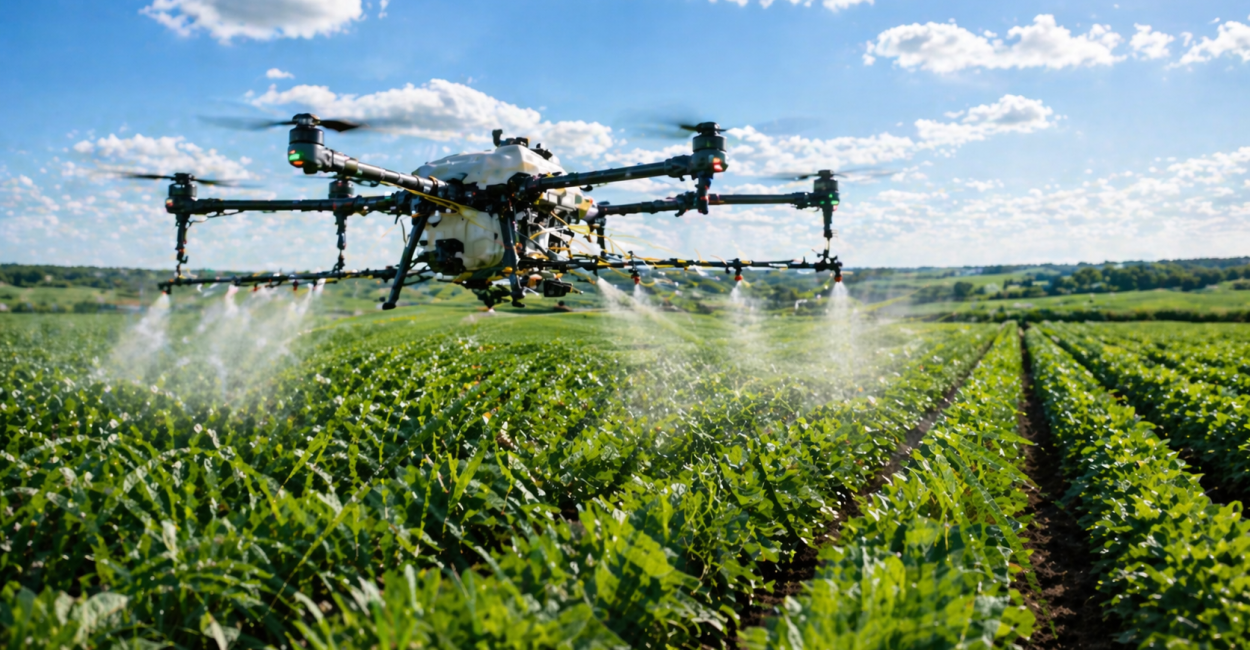
Every season a grower I know lost nearly 30% of a corn planting because a pest outbreak went undetected — until they bought a drone. Agricultural Drones deliver timely, high-resolution insight and targeted action that can literally save a harvest, and in 2026 this technology is essential for modern farms.
Choosing the wrong drone wastes money and time: the market is crowded with models for spraying, mapping, monitoring, and livestock counting. This guide lists the best agricultural drones to buy in 2026, tested and ranked by use case and budget, so you get the right tool for your farm fast.
We’ve covered agricultural technology and drones for years; this article is honest, hands-on, and organized by farm size, budget, and mission. Keep reading to find the exact drone that matches your farm size, budget and needs.
Why Agricultural Drones Matter for Modern Farms
What Agricultural Drones Do for Yield and Costs
Agricultural Drones offer rapid scouting, precision spraying, and accurate field mapping that traditional equipment can’t match. They reduce input use by targeting fertilizer and pesticides, crop scouting time, and labor costs. By catching stress and pest issues early, drones improve yield resilience and optimize resource allocation across the season.
Farmers see faster detection of disease, optimized application of chemicals, and better zone-based management when drones feed data into decision-support platforms. That combination increases net return per hectare and lowers environmental impact, a key driver for adoption in precision agriculture.
In short, agricultural drones enable actionable intelligence at field scale — faster, cheaper, and more targeted than manual scouting or satellite imagery alone.
Market Size and Timing to Buy
The global agricultural drone market is projected to reach roughly $9 billion in 2026, driven by falling hardware costs and maturing analytics. Adoption has accelerated across row crops, specialty crops, and livestock operations where quick intervention matters most.
For producers, 2026 is an attractive buy window: hardware prices have declined, sensors and spraying systems are more reliable, and software ecosystems are mature enough to integrate drone data into farm management systems effectively.
If you’re evaluating a purchase now, consider long-term integration with farm software and potential ROI from fewer inputs, earlier pest control, and better yield mapping.
Types of Agricultural Drone Applications
Agricultural drones support several core applications: spraying/pesticide application, multispectral and thermal crop monitoring, precision mapping with RTK/PPK, and livestock counting/tracking. Each use-case favors different airframes, sensors, and payload capabilities.
Spraying drones require heavy payloads and robust spray systems; monitoring drones prioritize camera quality and flight time; VTOL hybrids excel where long transit and site accessibility matter. Integration with farm data systems determines real value, so consider both hardware and software when choosing.
Matching mission to drone class is essential: small, light drones for quick scouting; medium multi-role platforms for mixed tasks; large agricultural sprayers for commercial application rates.
How to Choose the Right Agricultural Drone in 2026
Farm Size, Coverage and Operational Needs
Start by assessing farm acreage, hectare-per-hour coverage needs, and whether you need spraying, mapping, or thermal scouting. Small farms need lightweight, portable units; large agribusinesses need high-capacity sprayers or long-endurance VTOLs. The right drone reduces flight cycles and downtime.
Consider terrain and crop layout — orchards, row crops, and pastures have different line-of-sight and flight planning requirements. Also evaluate transport and launch logistics: does your crew need pick-up-truck portability or trailer-mounted support?
Plan for scalability: can the drone fleet grow or integrate into your existing precision ag workflows? That affects future ROI and operational complexity.
Budget Ranges and Total Cost of Ownership
Budgeting requires thinking beyond unit price: include training, spare batteries, payloads, insurance, and software subscriptions. Typical ranges in 2026: entry-level $500–$3,000, mid-range $3,000–$15,000, and professional $15,000–$40,000+. Higher upfront costs often pay back in lower labor and input expenses.
Factor in maintenance schedules and certification-related expenses if your operation requires licensed pilots. Leasing or service-based spray contracts can be an alternative to upfront purchase for high-capex platforms.
Always compute payback using realistic yield improvement and input savings, not best-case scenarios.
Primary Use Case and Payload Considerations
Match primary mission to payload type: sprayers need tanks and flow control; mapping needs high-res RGB and multispectral cameras plus RTK; livestock counting prefers thermal and zoom sensors for night and distance. Payload capacity, mounting flexibility, and modularity determine versatility.
Pay attention to flight time under full payload: a drone with great endurance empty may deliver far less when carrying tanks or heavy sensors. Also verify spare-parts availability and compatibility with third-party sensors if you plan customization.
Choose a drone ecosystem that supports sensors and software you’ll actually use for the tasks you prioritized during planning.
Connectivity, Software and Regulatory Compliance
Data Platforms and Software Integration
Connectivity and cloud workflows are central to the drone value proposition. A good agricultural drone pairs with farm management platforms for prescription maps, NDVI analysis, and treatment histories. Look for compatibility with common platforms (e.g., Climate FieldView, Agrian, FarmQA) and export standards (GeoTIFF, shapefiles).
Onboard processing and edge analytics speed up actionable insight, while cloud analytics centralize historical trend analysis. Data security, API access, and multi-user management are important for medium/large operations.
Ensure the drone’s software makes it easy to create prescription maps and export them to sprayer controllers or farm management systems without manual rework.
Regulatory Compliance and Certifications
Regulatory frameworks vary: FAA Part 107 and state rules in the U.S., ANAC guidance in Brazil, and EASA rules in Europe. Register drones above 249 g and ensure pilot certification where required. NDAA compliance matters for U.S. producers receiving federal funds or working with government contracts.
Some regions require operational waivers for beyond-visual-line-of-sight (BVLOS) spraying or night operations; plan compliance timelines into purchase decisions. Insurance, local flight restrictions, and environmental regulations for agrochemicals also shape your operational model.
Work with integrators or service providers to navigate registration, airspace authorization, and operator training when needed.
Connectivity, Security and Long-term Support
Connectivity choices (4G/5G, RF, mesh) affect command range and real-time telemetry; choose options that support secure firmware updates and encrypted data links. NDAA-compliant hardware can be required for certain customers and grants.
Manufacturer support, regional service centers, and parts availability influence uptime. For critical spraying windows, fast access to spare rotors or pumps matters more than small differences in specs.
Evaluate the vendor’s software update cadence and compatibility guarantees so your investment remains viable as platforms evolve.
Top Picks: 7 Best Agricultural Drones to Buy in 2026
DJI Agras T100 — Best for Large Scale Spraying
Specs quick: Tank: 100L | Coverage: 40+ acres/hour | Flight time: ~15 min per load. The Agras T100 is built for high-throughput spraying with advanced radar obstacle sensing and dual-atomization nozzles that improve droplet distribution for canopy penetration.
Ideal for commercial farms over 500 hectares, it reduces application time dramatically. The drone integrates with DJI Terra for mapping and prescription generation, and supports mission planning for multiple tanks and quick-turn battery swaps.
Pros: industry-leading capacity and spraying efficiency. Cons: steep initial cost and need for skilled operators; maintenance and logistics are more involved than small drones.
DJI Agras T50 — Best for Medium to Large Farm Spraying
Specs quick: Tank: 50L | Coverage: 20–30 acres/hour | Flight time: ~15 min. The T50 balances capacity and affordability, offering dual nozzles and obstacle sensing while remaining operator-friendly for cooperatives and mid-sized farms.
It’s ideal for operations between 100–500 hectares needing repeatable, accurate spray patterns with low drift. Integration with prescription maps makes targeted application straightforward and reduces chemical waste.
Pros: excellent cost-per-hectare for medium farms. Cons: not ideal for very small plots where portability and lower unit cost matter more.
DJI Mavic 3 Enterprise Thermal — Best for Crop Health Monitoring
Specs quick: Camera: 4/3 CMOS + thermal | Flight time: 45 min | Price: ~$5,000. Compact and portable, this platform delivers top-tier thermal imaging and high-resolution RGB for scouting and stress detection on a budget-friendly frame.
Perfect for agronomists and growers who need quick diagnostics and thermal disease or water-stress detection. Easy to deploy for repeated inspections and integrates with common photogrammetry pipelines for small-area mapping.
Pros: best-in-class thermal imaging for its size, great portability. Cons: not a spraying platform and limited coverage for very large farms.
Professional Mapping and NDAA-compliant Multi-sensor Options
DJI Matrice 350 RTK — Best for Professional Mapping and Surveying
Specs quick: Payload: 2.7 kg | Flight time: 55 min | RTK precision. The Matrice 350 RTK is a versatile industrial drone for high-accuracy orthomosaics, multispectral surveys, and customized sensor payloads. Hot-swappable batteries enable continuous operations during mapping campaigns.
Ideal for agronomists and service providers delivering high-precision maps, biomass indexes, and prescription layers. The platform supports multiple cameras and LiDAR integrations for advanced analytics and topographic mapping.
Pros: industrial-grade reliability and precision. Cons: complexity for beginners and higher training needs.
Autel EVO Max 4T V2 — Best for NDAA Compliance and Multi-sensor Ops
Specs quick: Four simultaneous cameras (wide, zoom, thermal, laser) | Flight time: ~42 min. This Autel platform satisfies NDAA compliance and is popular for U.S. operations that require government-friendly hardware and multi-sensor fusion for tasks like biomass monitoring and targeted scouting.
Great for producers with government contracts or who need a single platform for varied sensing tasks. It supports multi-drone operations and integrates with several analytics suites for prescription creation.
Pros: NDAA-compliant, sensor flexibility. Cons: software ecosystem less mature than some competitors; higher cost.
DJI Mini 4K — Best for Beginners and Small Farm Scouting
Specs quick: Weight: 249 g | Flight time: up to 62 min (combined with smart batteries) | Price: ~$500. Ultra-light and extremely portable, the Mini 4K is a low-cost entry to aerial scouting, offering excellent imagery for small fields and rapid inspections without registration hassles in many jurisdictions.
Perfect for hobby farmers, smallholders, and scouts who need fast visual checks and low-cost mapping when not carrying heavy sensors. Its ease of use minimizes training time and lowers the barrier to adoption for precision ag basics.
Pros: very affordable and accessible. Cons: lacks industrial sensors and cannot spray; limited expansion for professional workflows.
Extended-endurance and VTOL Platforms for Remote Operations
JOUAV CW-30E — Best for Extended Flight in Challenging Terrain
Specs quick: Type: VTOL hybrid | Flight time: 300+ min | Price: ~$25,000. The CW-30E hybrid uses gasoline-battery hybrid propulsion and VTOL capability to deliver exceptional endurance and range, ideal for mapping remote regions and large ranches where battery swaps are impractical.
It excels in terrain with limited landing sites thanks to vertical takeoff and landing, allowing long transects and fewer relays. The platform supports mapping sensors and long-range telemetry for expansive coverage in a single mission.
Pros: unmatched flight endurance and VTOL convenience. Cons: high operational complexity and maintenance needs compared with electric quadcopters.
Choosing Between Spray, Mapping and Hybrid Platforms
For spraying choose tanks and flow-control reliability; for mapping prioritize RTK/PPK accuracy and sensor quality; for remote coverage favor VTOL or hybrid endurance. Consider whether you’ll run single drones or fleets and how ground logistics (refill, battery swap, maintenance) will be managed.
Also evaluate training pathways and local support so downtime is minimized during peak application windows. Integration into your farm’s decision loop — from scouting to prescription to application — determines ultimate ROI.
When in doubt, pilot smaller platforms first and scale to specialized sprayers or hybrids as operational needs and budgets allow.
Comparing the 7 Best Agricultural Drones at a Glance
| Drone | Best For | Price |
|---|---|---|
| DJI Agras T100 | Large spraying | ~$35K |
| DJI Agras T50 | Medium spraying | ~$18K |
| DJI Mavic 3 Enterprise Thermal | Crop monitoring | ~$5K |
Quick Flight Time and Payload Snapshot
Flight time, payload, and NDAA compliance are the primary quick-filters for many buyers. Table rows above offer a snapshot; choose based on the core mission and how many hectares you need to cover during your application windows. Vendors and resellers can often provide farm-specific calculations.
For large-scope operations the T100 or CW-30E are compelling; for service providers and agronomists the Matrice 350 RTK or Autel EVO Max 4T V2 deliver sensor flexibility and regulatory compatibility. Smallholders benefit most from portable, low-cost drones like the Mini 4K for frequent scouting.
Always verify the latest firmware, local certification needs, and vendor warranty terms before purchase.
Drone Regulations and Operational Best Practices
Registration, Pilot Certification and Airspace Rules
Regulations vary: FAA Part 107 in the U.S., ANAC/DECEA in Brazil, and EASA rules across Europe. Many countries require registration for drones over 249 g and certification for commercial operations. BVLOS and night operations usually need special waivers.
Before buying, check local rules for spraying with UAVs — some regions have chemical application-specific rules and operator licensing for agrochemical handlers. Ensure pilots obtain required certificates and that the operation follows local environmental regulations.
Use trusted sources like FAA guidance or EASA documentation for current requirements and update procedures as laws evolve.
Safety, Insurance and Environmental Rules
Insure your drone fleet for liability and hull damage, especially when spraying near people or infrastructure. Maintain a safety management plan covering pre-flight checklists, no-fly zones around critical infrastructure, and procedures for failed missions or chemical spills during refilling.
Follow environmental rules for spray drift mitigation, using buffer zones and approved droplet sizes. Keep records of applications tied to GPS logs for traceability and compliance.
Partner with local extension services or certified applicators if you lack in-house expertise for regulated chemical applications.
Where to Learn and Get Certified
Operator training programs run by manufacturers, agricultural universities, and certified flight schools provide practical spray and mapping instruction. Many vendors offer bundled training with purchases; third-party academies provide deep courses on mission planning, payload management, and data workflows.
Hands-on practice under supervision accelerates safe operations and boosts ROI because competent crews fly more efficiently and avoid costly mistakes. Seek courses that include chemical handling and spray calibration when planning to use drones for agrochemical applications.
Local extension agencies and industry groups often list reputable training providers and can help with grant or subsidy information for acquisitions.
How to Maximize Drone ROI on Your Farm
Training, Maintenance and Operational Discipline
Invest in operator training and preventive maintenance. Certified pilots reduce crash risk and chemical mishaps; scheduled maintenance and spare part inventories minimize downtime. Track flight hours, battery cycles, and component life to plan replacements before failures occur.
Small process improvements — dedicated refilling stations, standardized pre-flight checklists, and logistics for battery charging — improve uptime dramatically over ad-hoc operations. Use maintenance logs and a CMMS-style approach for larger fleets.
Well-trained crews and disciplined maintenance are often the single biggest contributors to drone ROI over time.
Software, Analytics and Prescription Workflows
Use analytics platforms that turn raw imagery into actionable prescriptions: NDVI-based variable-rate fertilizer maps, targeted spray zones for pest hotspots, and yield-loss overlays. Integration with your farm management system ensures prescriptions are applied and archived for traceability.
Subscription costs add to TCO, but good software multiplies drone value by converting flights into repeated, measurable decisions that save inputs and increase yields. Prioritize platforms with open export standards for long-term flexibility.
Automate routine flights and integrate drone schedules with agronomic windows to maximize the value of each sortie.
Calculate Payback and Scale Thoughtfully
Calculate payback by estimating labor and input savings, plus yield improvements attributable to earlier interventions. Use conservative assumptions for adoption curves and realistic chemical savings to model payback periods. For many mid-size operations, payback occurs in 1–3 seasons when drones replace contract spraying or improve pest control timing.
Start with one platform for high-value, time-sensitive tasks, then scale to a fleet as you validate assumptions and tighten workflows. Consider service-provider partnerships if upfront capex is a barrier.
Track KPIs—hectares per hour, treatments per season, application accuracy—to evaluate whether to expand your drone assets.
Conclusion
There is a right drone for every farm: the Agricultural Drones market offers solutions that range from affordable scouting with the DJI Mini 4K to industrial spraying with the DJI Agras T100. Match mission, budget, and regulatory needs to your farm size and you’ll see measurable savings and faster response to pests and stress.
For beginners, start with the DJI Mini 4K; for large-scale spraying operations, the DJI Agras T100 is the top recommendation. Which drone are you considering for your farm? Tell us in the comments — we’ll help you decide.
FAQ
What Are the Key Benefits of Using Agricultural Drones?
Agricultural drones provide rapid, high-resolution field insights that enable earlier pest detection, targeted spraying, and precise field mapping. They reduce input use and labor, speed decision-making, and improve traceability. For many farms, these gains translate into measurable ROI through lower chemical costs and higher yields within a few seasons.
Do I Need Certification to Fly a Drone for Farm Work?
Certification depends on jurisdiction: in the U.S., commercial operations typically require FAA Part 107 certification; other countries have equivalent rules. Spraying operations may require additional licenses for handling agrochemicals and airspace waivers for BVLOS or night work. Check local aviation authority guidance before operating.
Which Sensors Are Most Useful for Crop Health Monitoring?
Multispectral sensors (for NDVI/vegetation indices), thermal cameras (for water stress and livestock monitoring), and high-resolution RGB cameras (for scouting and mapping) are the most useful. Combining sensors in a single mission yields richer analytics and better prescription accuracy for inputs.
How Do I Decide Between Buying a Drone and Hiring a Service Provider?
Buy if you need frequent, on-demand flights and have volume to justify the capex and operational overhead. Hire a service provider if your needs are seasonal or irregular, or if you prefer to avoid maintenance, certification, and training costs. Compare expected sorties per season and total cost of ownership to decide.
Are NDAA-compliant Drones Necessary for All U.S. Farmers?
NDAA compliance is necessary primarily for operations working with federal contracts or receiving certain grants that require non-Chinese manufactured hardware. For many private farms it isn’t mandatory, but NDAA-compliant models are preferred for government-linked projects and some institutional buyers.
Sources: FAA guidance, EASA regulations, and industry market reports (2026 drone market projections) for global context.