Skip to content
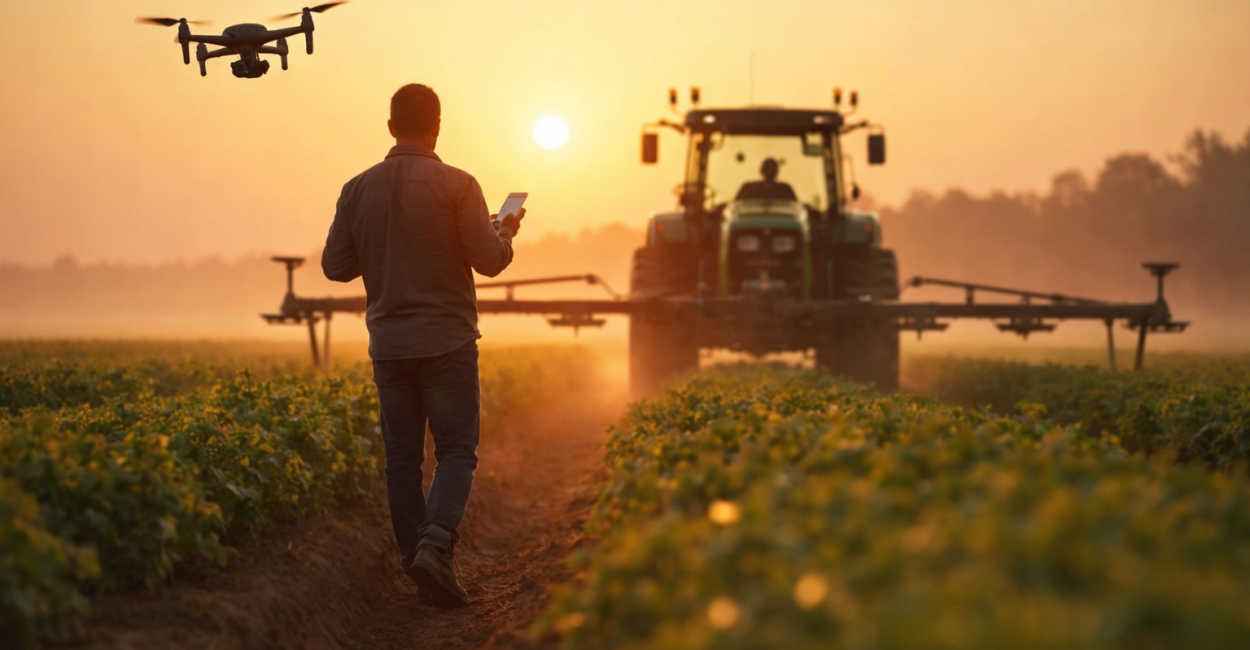
Refers to the application of machine learning, computer vision, robotics, remote sensing, and predictive analytics to manage farms at field and plant level with high spatial and temporal resolution. At its core it replaces coarse, uniform decisions with data-driven, localized actions: variable-rate inputs, targeted pest control, and predictive harvesting. This definition emphasizes integration across hardware, software, and agronomic models to close the loop between sensing, decision, and automated action.
Pontos-Chave
- AI in precision agriculture reduces input costs by 15–40% in measured trials by enabling variable-rate application and targeted interventions that cut waste and improve resource use efficiency.
- High-value gains come from combining multi-source data—satellite, drone, soil probes, and machines—into operational models that translate predictions into on-the-go actuation.
- Scaling AI requires robust data pipelines, edge compute for latency-sensitive tasks, and governance around labels and ground truth to avoid biased models that misallocate inputs.
Why Sensor Fusion Determines ROI in AI in Precision Agriculture
Sensor fusion—combining satellite imagery, multispectral drone data, in-field probes, and machine telemetry—creates the contextual view AI models need to make reliable prescriptions. Single-source models often fail when cloud cover, probe failure, or machine drift changes the data distribution. Fusion improves robustness by leveraging complementary temporal and spatial scales: satellites give weekly wide-area trends, drones capture plant-level stress, and probes measure soil properties at root depth. Farmers capture ROI when models translate fused inputs into consistent, repeatable actions that reduce inputs or increase yield.
Best Practices for Fusing Remote and Proximal Sensing
Start with consistent georeferencing and time-sync across platforms. Use radiometric calibration for multispectral sensors to align indices like NDVI and NDRE. Build a tiered pipeline: daily satellite composites for trend detection, weekly drone flights for targeted mapping, and continuous probes for soil state. Train ensemble models that weight sensors by confidence and availability. Validate with randomized ground-truth sampling across management zones to control selection bias. This reduces false positives for stress detection and raises prescription precision.
Implications for Hardware Choices and Data Cost
Not all farms need high-end drones; often lower-cost sensors plus well-placed probes plus cheap satellite data deliver most of the value. Edge compute can lower data transfer costs by pre-processing imagery on-farm. The tradeoff is capital vs. recurring data fees—satellite APIs and high-fly drone services add operating cost while probes are capital-heavy. Effective procurement aligns sensor choice to the agronomic question: is the goal early disease detection, nutrient mapping, or yield forecasting? Each requires different fidelity and revisit rates.
How Machine Learning Models Translate Data Into Actionable Prescriptions
Models in AI in precision agriculture convert raw measurements into actionable rules: when and where to apply fertilizer, when to scout for pests, and which zones to harvest first. The most useful models blend physics-based crop models with data-driven corrections. Purely statistical models can be brittle across seasons; coupling them with crop-growth models reduces out-of-sample risk. Model outputs should be probabilistic and calibrated so operators can weigh cost of action against likelihood of benefit. Automation succeeds when prescriptions include confidence and recommended margins for safety.
Model Types and Deployment Modes
Common architectures include convolutional networks for imagery, gradient-boosted trees for tabular sensor data, and hybrid digital twin frameworks for scenario simulation. Real-time tasks (weed removal by robot) require edge models with <100 ms inference latency. Strategic tasks (seasonal fertilizer plans) can run in the cloud with richer ensembles. Continuous learning frameworks that incorporate new harvest data prevent model drift. Crucially, models must export interpretable prescriptions—maps, VRA files, or machine commands—compatible with existing farm equipment standards like ISOXML and AgGateway formats.
Reducing Model Risk with Validation and Governance
Validation requires multi-year, multi-site trials with randomized zones to measure true treatment effect. Holdout across seasons and soil types helps quantify generalization. Create governance around labels: pest incidence, yield, and management actions must use standardized ontologies. Log every intervention to allow causal inference. For risk-averse operators, provide rollback strategies and safe defaults. Good governance lowers the chance of overfitting to a single season and helps suppliers prove value to conservative buyers.
Robotics and Automation: Operationalizing AI in Precision Agriculture
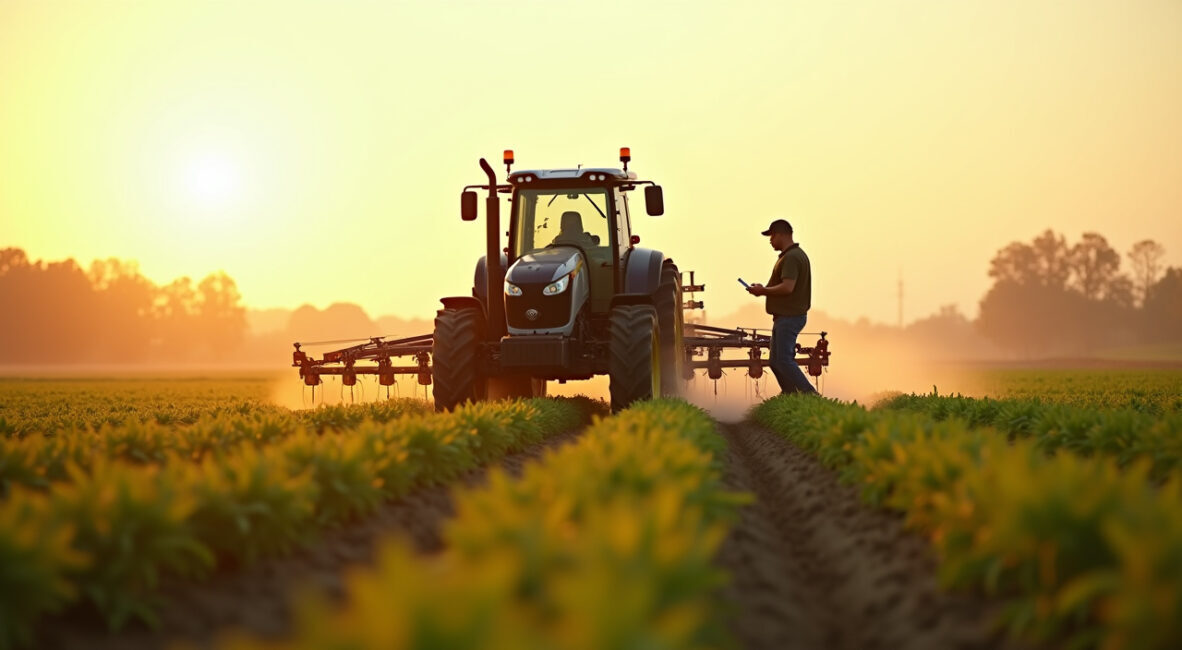
Robotics turns AI-derived prescriptions into physical actions—variable-rate applicators, autonomous tractors, robotic weeders, and targeted sprayers. The operational challenge is tight integration between perception stacks and control systems. Visual perception must handle dust, motion blur, and occlusion. Control needs robustness to uneven fields and variable traction. Success hinges on incremental automation: start with assisted modes (operator supervises) before full autonomy. That limits catastrophic errors while building operator trust and collecting high-quality interaction data.
Case Studies: Robotic Weeding and Selective Spraying
Commercial robotic weeders have reduced herbicide use by 60–90% in experimental plots by mechanically removing weeds or applying micro-doses of herbicide. Selective sprayers using computer vision apply chemicals only to detected targets, cutting chemical use by up to 70% in row crops. These savings depend on detection precision and actuation speed; at high speeds, false positives rise. Thus, operators must tune speed vs. accuracy and maintain labeled datasets for common weed species found on their farms.
Integration with Farm Workflows and Labor
Automation changes workforce needs rather than simply reducing labor. Operators move from manual application to supervision, system tuning, and data analysis. Smaller teams with digital skills oversee larger workflows. Training programs should pair equipment vendors with agronomists to transfer tacit knowledge. Implementation plans that ignore human factors—like reaction to alarms or maintenance routines—fail more often than those that focus exclusively on tech specs.
Data Pipelines, Edge Computing, and Cybersecurity for Smart Farms
Reliable pipelines are the backbone of AI in precision agriculture. Raw telemetry must be ingested, cleaned, labeled, and versioned. Edge compute addresses bandwidth and latency by filtering and summarizing data on-site. Use MQTT or secure REST APIs for telemetry, and maintain a single source of truth in cloud storage with immutable datasets for audit. Cybersecurity must protect telemetry and actuator channels: unencrypted links can allow malicious commands. Treat farms like industrial control systems with role-based access and logging.
Design Patterns for Resilient Pipelines
Adopt event-driven architectures: sensors push deltas, preprocessing occurs at the edge, and cloud jobs handle heavy model retraining. Use time-series databases for probe and machine telemetry and object stores for imagery. Version datasets and models with tags that include season and equipment firmware. Implement monitoring for data drift and sensor failure to trigger re-calibration or fallbacks. This reduces silent model degradation and helps diagnose root causes when prescriptions go wrong.
Security and Data Ownership
Negotiate clear data ownership terms with vendors. Farmers must retain rights to raw data and derived prescriptions or receive compensation for their use. Encrypt data at rest and in transit, and apply multi-factor authentication for control interfaces. For critical actuation channels, implement two-step confirmations. Regulatory frameworks are emerging; align practices with standards from industry groups like AgGateway and cybersecurity guidance from the USDA and NIST for critical infrastructure.
Economic and Environmental Impact: Measured Outcomes and Trade-offs
AI in precision agriculture promises both cost savings and environmental benefits, but outcomes vary. Peer-reviewed trials report input reductions of 15–40% and yield uplifts of 5–15% depending on crop and baseline practice. Environmental gains—reduced runoff, lower greenhouse gases—depend on scale and adoption fidelity. Economic returns also hinge on equipment integration and learning curves; early adopters face higher per-acre costs. Decision-makers must evaluate net present value over 3–5 years and include training and maintenance in budgets.
Quantifying Benefits: Metrics That Matter
Measure outcomes with standardized KPIs: input cost per hectare, yield per hectare, profit per hour, and environmental indicators such as nitrogen surplus and pesticide load. Run A/B field trials and track confidence intervals, not just point estimates. Use life-cycle accounting where machinery and sensor manufacture impacts are considered. Transparent measurement builds trust and supports farmer-to-farmer diffusion when numbers are credible and replicable across regions.
Potential Adverse Effects and Mitigation
Misapplied AI can increase inequality: large farms capture most gains due to scale, while smallholders may be priced out. Data monopolies can lock farmers into vendor ecosystems. To mitigate, promote interoperable standards, cooperative ownership models, and public data-sharing programs. Public funding for benchmarking trials and open-source tools can lower barriers and ensure benefits reach broader communities.
Standards, Partnerships, and Pathways to Scale
Scaling AI in precision agriculture requires standards and multi-stakeholder partnerships. Standards for data exchange and machine command formats reduce integration friction. Public-private partnerships fund testbeds and create shared datasets that improve model generalization. Extension services and universities play a role in translating models to local conditions. Clear certification paths for AI tools—covering accuracy, safety, and environmental claims—will accelerate adoption by risk-averse operators.
Standards and Interoperability
Adopt AgGateway and ISOXML for data exchange, and follow sensor calibration protocols from standards bodies to ensure reproducibility. Interoperability reduces vendor lock-in and allows farms to mix-and-match best-of-breed systems. Certification frameworks that validate model performance under defined conditions will raise baseline quality and protect farmers from overpromised yields.
Partnership Models That Work
Effective partnerships pair tech firms with agronomy providers and co-op networks. Tech provides models and hardware, agronomists provide ground truth and domain knowledge, co-ops enable scale and data aggregation. Public funding for shared infrastructure—like drone-pilot training and regional labeled datasets—accelerates trust and uptake, especially in regions with fragmented landholdings.
How to Apply This: Practical Rollout Plan for a Mid-size Farm
A pragmatic rollout starts with a pilot focused on a single, high-impact use case: for example, nitrogen management in a cereal crop. Define success metrics, reserve randomized control strips, and collect pre-implementation baseline data. Choose sensors that match the use case: soil nitrate probes plus weekly satellite NDVI. Deploy models with conservative thresholds and provide operator dashboards with clear actions. After 1–2 seasons, analyze economic and agronomic outcomes, iterate, and expand to other fields or crops.
Stepwise Implementation Checklist
- Define measurable objectives and KPIs.
- Pick one pilot field and one clear use case.
- Establish ground-truth sampling and randomized controls.
- Deploy sensors and simple edge preprocessing.
- Run models in parallel with standard practice, then compare.
- Scale gradually after demonstrating positive NPV and stable models.
Analysis of pilot results should include sensitivity tests and failure modes. Allocate budget for training, maintenance, and data storage. Prioritize interoperability when selecting vendors to avoid costly rip-and-replace cycles.
Próximos Passos Para Implementação
Adopt a staged approach: validate technical feasibility in a controlled pilot, demonstrate economic return, then scale while building local capacity. Prioritize sensors and models that address your farm’s largest cost centers, and insist on data portability when signing vendor contracts. Invest in training so operators can interpret probability-based prescriptions. Finally, collaborate with peers and extension services to share benchmark data. These steps reduce technical and financial risk and increase the chance that AI in precision agriculture delivers durable farm-level and environmental benefits.
How Accurate Are AI-driven Yield Forecasts Compared to Conventional Methods?
AI-driven yield forecasts typically combine remote sensing, weather, and crop models to achieve higher spatial resolution than conventional methods. Reported accuracy varies by crop and region, but recent peer-reviewed studies show mean absolute error reductions of 10–25% compared to agronomic rule-of-thumb forecasts. Accuracy improves with multi-year training data and local calibration. Critical factors include cloud-free imagery, up-to-date management records, and soil data. Operators should treat forecasts as probabilistic inputs and validate them with in-season sampling to refine decisions.
What Data Volume and Quality Does a Farm Need to Deploy Effective AI Models?
Effective AI models require representative, labeled datasets rather than sheer volume. For many tasks, a few seasons of well-annotated data across soil types and management zones suffice. Key requirements are consistent georeferencing, timestamps, clear labels for outcomes like yield or disease incidence, and metadata for sensors. For imagery tasks, hundreds to thousands of labeled images per class are common. Data quality trumps quantity—systematic noise or mislabeled samples degrade model trust. Start small, validate, then expand data collection strategically.
Can Small and Medium Farms Realistically Benefit from AI in Precision Agriculture?
Yes. Small and medium farms can capture significant benefits by targeting high-value problems: reducing expensive inputs, improving market-timed harvests, or increasing quality grades. Shared services—drone operators, cooperatives, or software-as-a-service platforms—lower capital barriers. The key is affordable sensors, clear ROI pilots, and interoperable systems to avoid vendor lock-in. Public programs and extension services can accelerate adoption by offering training and access to shared datasets. Scale need not be a prerequisite for benefit.
How Do You Ensure AI Models Remain Valid Across Seasons and Changing Conditions?
Preventing model drift requires continuous monitoring, periodic retraining with recent season data, and domain adaptation techniques. Implement data drift detectors for input distributions and performance monitors for prediction quality. Maintain a versioned dataset and model registry so you can roll back if performance degrades. Use hybrid models that embed agronomic constraints to improve generalization. Regular ground-truth sampling across representative fields provides the labels needed for retraining and keeps models aligned with evolving conditions.
What Governance and Contractual Clauses Should Farmers Insist on with AI Vendors?
Farmers should require clauses that guarantee data ownership, access to raw and processed data, portability of models and prescriptions, and transparent pricing for data services. Include service-level agreements for uptime, support, and model performance thresholds. Require audit logs of all automated actions and the ability to opt out of data-sharing programs. Clarify liability for incorrect prescriptions and include termination terms that return or delete data. These clauses protect farmers from lock-in and ensure fair value exchange.