Skip to content
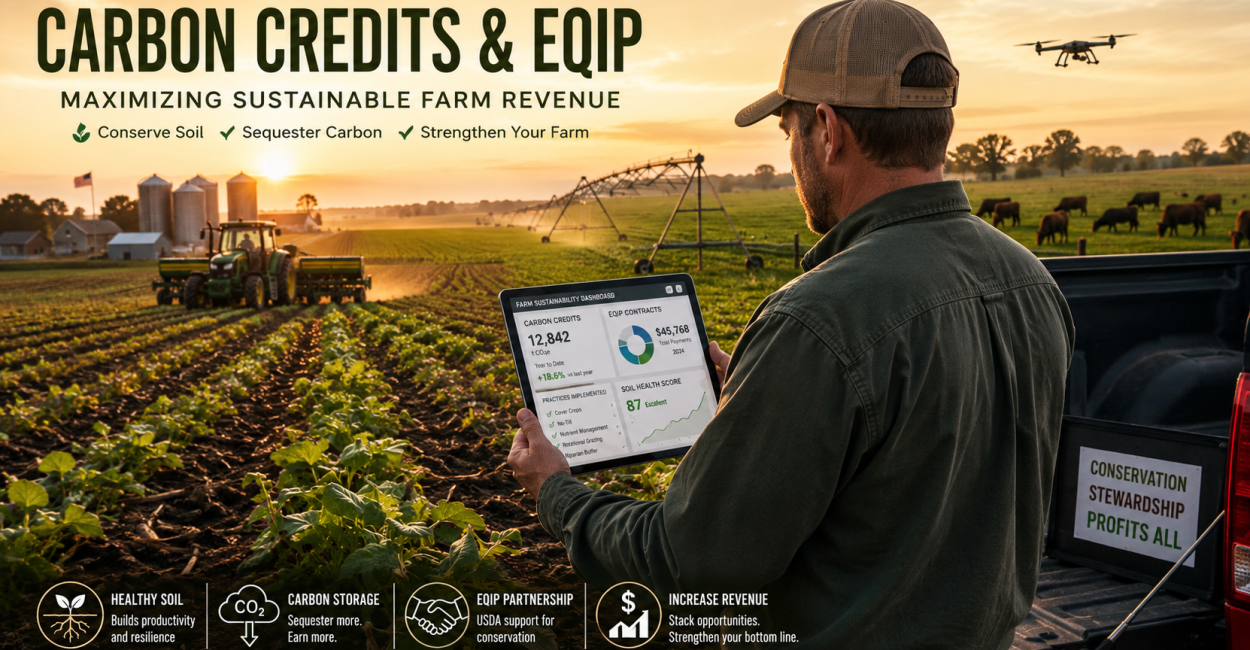
Can you stack carbon credits with EQIP payments? The short answer is: it depends. This question has become increasingly relevant as farmers and landowners seek to maximize the financial benefits from both federal conservation programs and private carbon markets. The Environmental Quality Incentives Program (EQIP), administered by the USDA Natural Resources Conservation Service (NRCS), provides cost-share payments to implement conservation practices. Meanwhile, carbon credit programs offer payments for the carbon sequestration benefits of those same practices. But stacking—or receiving payments from both sources for the same environmental benefit on the same acreage—is not straightforward. Federal rules prohibit double compensation for identical outcomes, yet private carbon programs vary widely in their policies. Understanding these nuances can protect producers from legal risks and optimize their revenue streams.
As more private carbon initiatives emerge alongside established USDA programs like EQIP and the Conservation Stewardship Program (CSP), farmers must navigate a complex landscape. Some carbon programs explicitly allow stacking with EQIP, others forbid it, and many remain silent—introducing uncertainty. This article digs into the federal regulations governing EQIP stacking, examines leading carbon programs’ approaches, and offers practical guidance on how to evaluate contracts before enrolling. Drawing on authoritative sources like Iowa State University Extension, USDA regulations, and industry reports, this analysis equips producers with the knowledge to make informed decisions in 2026’s evolving conservation finance environment.
Key Insights
- Federal EQIP contracts prohibit duplicate payments for the same environmental benefit on the same land, but allow payments for different practices or outcomes in the same operation.
- Carbon credit programs differ: outcomes-based programs like Indigo Ag require strict additionality and often restrict stacking; practice-based programs like Bayer Carbon are generally more permissive.
- Stacking risk arises when EQIP pays for practice adoption (e.g., cover crops) and a carbon program pays for the carbon benefit of that same practice on the same acres.
- USDA’s Climate-Smart Commodities pilot is designed to complement EQIP, generally permitting stacking by paying for distinct outcomes.
- Before enrolling, producers should verify contract language, compare covered practices and acres, confirm additionality requirements, and seek written approval from both NRCS and carbon program agents.
The Federal Rule — What EQIP Actually Prohibits
Understanding the Baseline Regulation
The core federal regulation governing EQIP and stacking is found in 7 C.F.R. §1466.36. Every EQIP contract includes a clause that prohibits producers from taking any action that defeats the program’s purpose, explicitly including double payments for the same environmental benefit on the same land. This means you cannot receive cost-share from EQIP for a conservation practice and then also receive payment from another program for that exact same benefit on the same acres.
In plain terms, EQIP’s rule is simple: no double-dipping for the same environmental service. However, it does allow payments from different programs for different activities or benefits. For example, EQIP might pay to install fencing for pasture management, while CSP pays annual incentives for grazing management enabled by that fence—two distinct benefits on the same operation. This distinction is critical because it sets the boundaries of what “stacking” means legally and practically.
Examples of Permitted and Prohibited Stacking
Allowed: EQIP pays 50% cost-share to install a drip irrigation system (practice 449). Separately, a carbon program pays for nutrient management improvements on the same acres. Since the practices and benefits differ, stacking is permitted.
Prohibited: EQIP pays cost-share for cover crop establishment on 200 acres. A carbon credit program pays for carbon sequestration from those same cover crops on the identical acres. Because both payments compensate the same environmental benefit from the same practice, this is considered duplication and violates EQIP terms.
The Role of Additionality
Additionality is a cornerstone of carbon credit legitimacy. It requires that the carbon-sequestering practice would not have been implemented without the carbon market incentive. If EQIP has already incentivized a practice like cover crops, the carbon program’s claim of additionality is weakened. Programs like Indigo Ag and Climate Action Reserve rigorously enforce this, often excluding acres already covered by EQIP cost-share. In contrast, practice-based programs such as Bayer Carbon, which pay for adoption rather than verified offset credits, often allow stacking more flexibly.
Program-by-Program — What Each Carbon Program Allows
Indigo Ag and Climate Action Reserve (CAR)
Indigo Ag operates an outcomes-based model requiring demonstration of additionality per CAR standards. Their contracts often disallow stacking where EQIP has paid for the same conservation practice on the same acres. The policy requires consultation with local agents, and contracts specify stacking restrictions explicitly. While stacking is challenging under Indigo, it is not impossible if the carbon practice goes beyond EQIP’s coverage.
Bayer Carbon (ForGround)
Bayer’s program is practice-based, paying a flat rate per acre for adoption of conservation practices rather than verified carbon offsets. Because it treats payments as supply chain incentives rather than direct carbon offsets, Bayer generally permits stacking with EQIP. Retroactive payments reaching back to 2019 include many producers with active or prior EQIP contracts. However, verifying contract terms remains essential because some restrictions may apply.
Cargill RegenConnect
RegenConnect is an inset program where practice data contributes to Cargill’s Scope 3 greenhouse gas reporting but does not generate negotiable carbon credits. This reduces conflicts with EQIP’s anti-duplication clauses. Stacking is typically compatible, but producers should review contract documentation for confirmation.
Truterra (Land O’Lakes)
Truterra’s program allows retroactive participation dating to 2016, so many enrolled farms have EQIP history. Their stacking policy is not broadly publicized, requiring direct confirmation from Truterra representatives. Given this uncertainty, producers should verify eligibility before enrolling acres with active EQIP contracts.
USDA Climate-Smart Commodities Pilot
This $700 million USDA pilot program coordinates closely with EQIP and CSP. It is explicitly designed to complement rather than duplicate federal payments. Because Climate-Smart Commodities pay for outcomes such as reduced carbon intensity, distinct from EQIP’s cost-share for implementation, stacking is generally allowed and less legally risky than with private programs.
| Program | Allows Stacking with EQIP? | Type | Notes |
|---|---|---|---|
| Indigo Ag | Conditional | Outcomes-based | Strict additionality; consult local agent |
| Bayer Carbon | Generally yes | Practice-based | Verify contract |
| Cargill RegenConnect | Generally yes | Inset (not offset) | Check documentation |
| Truterra | Uncertain | Practice-based | Contact representative |
| USDA Climate-Smart | Yes (designed for) | Federal | Best compatibility |


The “Same Practice, Same Acres” Problem
Why This Scenario is Risky
Imagine a producer with an active EQIP contract paying 50% cost-share for cover crops on 200 acres. The same producer signs up for Indigo Ag’s carbon program to generate credits from those cover crops on the identical acreage. NRCS could view the carbon payment as duplicate compensation, potentially requiring repayment of EQIP funds. Simultaneously, carbon verifiers might reject credits if additionality cannot be demonstrated, invalidating the carbon income.
A Safer Alternative
A less risky approach is stacking payments for genuinely different practices or benefits on the same land. For example, EQIP funds irrigation system installation while a carbon program pays for nutrient management improvements or rotational grazing practices. These distinct practices produce separate environmental benefits, making stacking legally and operationally safer.
Insights from Iowa State University Extension
ISU Extension highlights that farmers in Iowa can earn approximately $30 per acre per year over ten years for implementing no-till and cover crops, assuming no stacking conflicts. This underscores the financial potential but also the importance of careful contract management to avoid losing eligibility or payments.
What to Check Before Signing Both Contracts
- Review Your EQIP Contract’s Stacking Clause: Even if private carbon programs aren’t explicitly mentioned, the general prohibition on duplicate payments applies. Consult your NRCS representative before enrolling.
- Map Practices and Acres: Create a detailed table matching EQIP-covered practices and acres with those in the carbon program to identify overlaps.
- Examine Carbon Program Stacking Policies: Look for contract sections on government payments or co-benefits. If unclear, request written confirmation.
- Consider Timing: Additionality is assessed at carbon enrollment. Enrolling in carbon programs after starting EQIP weakens additionality claims. Ending EQIP before carbon enrollment strengthens it but forfeits cost-share.
- Obtain Written Confirmation: The safest approach is documented approval from both NRCS and the carbon program confirming compatibility and eligibility.
- Verify Different Benefits: Confirm that payments cover distinct environmental services, not overlapping benefits from the same practice.
EQIP + CSP Together — The Stack That’s Designed to Work
How USDA Programs Complement Each Other
EQIP and CSP are designed to be stacked. EQIP funds the one-time implementation costs of conservation practices, while CSP provides annual payments for maintaining those practices and incentivizing enhancements. Combining these programs, sometimes alongside FSA loans or state funding, can increase financial support significantly without violating program rules.
Difference from Private Carbon Stacking
Adding a private carbon program on top of EQIP + CSP introduces complexity because carbon payments often claim the same environmental benefits. USDA’s internal coordination reduces duplication risk between EQIP and CSP, but private programs require careful contract scrutiny and verification to avoid conflicts.
The Math — Is It Worth the Complexity?
Example Scenario: 200 Acres Corn-Soy in Iowa
- EQIP: 50% cost-share for cover crops at $35/acre = $17.50/acre, totaling $3,500 per year for 3 years.
- CSP: Annual enhancements for rotation and cover crops, $40–$60/acre = $8,000–$12,000 per year.
- Bayer Carbon: $6/acre for cover crops + $6/acre for strip-till = $12/acre, totaling $2,400 per year.
Total potential annual income: $3,500 (EQIP) + $10,000 (CSP average) + $2,400 (Bayer) = $15,900.
Compared to only EQIP’s $3,500, stacking can add $12,400 annually. However, this assumes Bayer Carbon payments are compatible with EQIP contracts. If NRCS determines duplication, producers risk losing EQIP funds or repaying past payments. This underscores the non-negotiable need for pre-enrollment verification.
Next Steps for Implementation
Understanding the federal rule that prohibits duplicate payments but allows payments for distinct conservation activities is essential for navigating carbon credit stacking with EQIP. Practice-based carbon programs tend to coexist more comfortably with EQIP than outcomes-based programs, which impose stricter additionality requirements. The key to successful stacking lies in thorough contract review, mapping of practices and acres, and confirming eligibility with both NRCS and carbon program representatives.
Producers who proactively verify stacking policies and avoid overlapping payments can unlock significant additional revenue streams without risking contract violations or credit invalidation. As the landscape evolves, staying informed and consulting authoritative sources like USDA NRCS guidelines and Iowa State University Extension publications will remain critical.
For those managing multiple conservation finance sources, combining EQIP and CSP remains the safest, most established stack. Adding carbon credits can amplify benefits but demands caution and due diligence. Prioritize transparency and documentation to protect your operation and maximize financial returns.
- Download our Carbon-EQIP Stacking Checklist to systematically evaluate your contracts.
- Read our full carbon credit program comparison for detailed policy insights.
- Contact your local USDA Service Center to verify program compatibility before enrolling.
FAQ
Can I Receive EQIP Payments and Carbon Credits for the Same Cover Crop Acres?
Generally, no. EQIP contracts prohibit duplicate payments for the same environmental benefit on the same land. Receiving cost-share from EQIP for cover crop establishment and carbon credits for the carbon sequestration from those identical acres usually violates federal rules. However, stacking might be allowed if the carbon program’s payments are for distinct benefits or practices beyond EQIP’s scope.
How Do Carbon Programs Define Additionality in Relation to EQIP?
Additionality means the practice wouldn’t have occurred without carbon market incentives. If EQIP has already incentivized a practice, some carbon programs—especially outcomes-based ones like Indigo Ag—may reject those acres as non-additional. Practice-based programs like Bayer Carbon have more flexible additionality criteria, allowing stacking in more cases.
Is Stacking Allowed Between EQIP and USDA’s Climate-Smart Commodities Pilot?
Yes. The Climate-Smart Commodities pilot is designed to complement EQIP and CSP. It typically pays for different outcomes, such as reduced carbon intensity, while EQIP funds implementation costs. This coordination reduces duplication risk and generally permits stacking within USDA programs.
What Are the Risks If I Stack Payments Improperly?
Violating EQIP’s anti-duplication clause can lead to contract termination or repayment of EQIP funds. Additionally, carbon credits may be invalidated if verifiers determine a lack of additionality. Producers risk losing financial benefits and facing legal complications, so careful contract review and confirmation are essential.
What Practical Steps Should I Take Before Enrolling in Both EQIP and a Carbon Program?
First, read your EQIP contract’s stacking clauses and consult your NRCS representative. Map out which practices and acres are covered by each program. Review the carbon program’s stacking policies and request written confirmation if unclear. Consider timing to strengthen additionality claims, and always seek documented approval from both parties before enrolling.