Skip to content
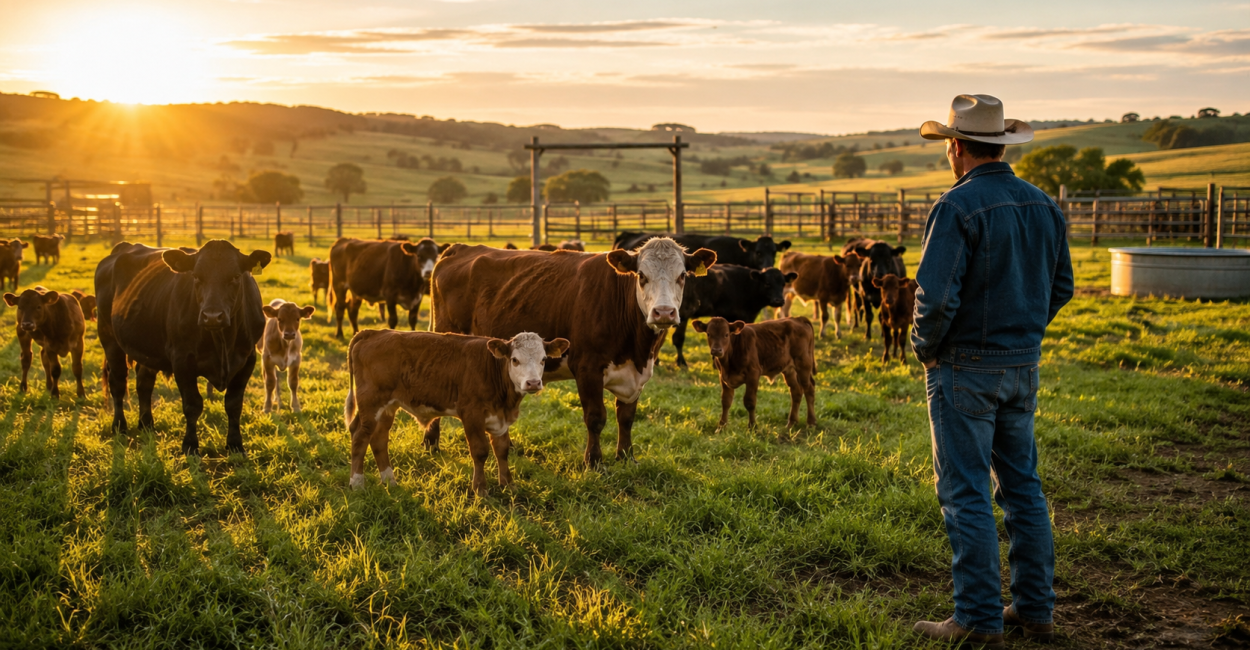
The cow-calf operation is a cornerstone of the U.S. beef industry, serving as the foundation where calves are born and raised before moving on to feedlot stages. Understanding the financial dynamics of running a cow-calf operation in 2026 is essential for producers aiming to thrive in a market shaped by tightening supply and fluctuating costs. This article explores the actual costs, break-even points, and strategic actions that separate profitable operations from those struggling to stay afloat.
As the American cattle herd contracts by approximately 1%, the 2026 calf crop will be smaller, tightening feeder cattle supplies. While this signals opportunity, it comes with the editorial tension of rising operational costs, which have increased 29% over the last five years. Managing these costs effectively—not just relying on calf prices—is the key to unlocking profitability. Using the latest data from the University of Kentucky Extension, this article breaks down costs by category and highlights the best practices in feed, reproduction, and pasture management that top producers use to maximize returns.
The 2026 Market Setup — Why This Year is Unusual
Key Supply Factors Shaping 2026
- American cattle herd decreased roughly 1% in the last year, leading to a smaller 2026 calf crop.
- Ongoing liquidation cycle initiated by the 2022–2023 Southern Plains drought.
- Retention of heifers expected in 2026 will further tighten feeder cattle supply.
- Strong consumer demand for beef continues despite supply constraints.
- Producers face a unique combination of lower supply and higher prices.
Projected Calf Prices for 2026
Fall 2026 calf prices for 550 lb steers and heifers are projected between $3.50 and $4.00 per pound, averaging $3.75, approximately $0.20/lb higher than fall 2025 prices. USDA ERS forecasts feeder steer prices (750–800 lb, Oklahoma City) around $357/cwt for 2026. Elevated prices reflect the shrinking herd, strong demand, and tight feeder cattle availability.
Cost Trends and Outlook for 2026
Total cash costs, including pasture rent, are forecasted at $1,044 per head in 2026, slightly below the $1,069 estimated for 2024. Feed costs show modest relief compared to 2023–2024 but remain 29% above the five-year average. This creates a favorable market environment—tight supply, strong prices, and slightly declining costs—the best since 2014–2015, although poorly managed operations may still face losses.
What It Actually Costs to Run a Cow for a Year in 2026
Operating Costs Breakdown
- Purchased feed (supplements, grain): $85–$120 per cow annually
- Hay and harvested forage: $180–$280 per cow annually
- Pasture rent or imputed cost: $200–$350 per cow annually
- Veterinary and medication: $45–$55 per cow
- Salt and minerals: $40–$50 per cow
- Bull costs (depreciation and maintenance): $80–$120 per cow
- Marketing (commissions and transport): $50–$90 per cow
- Fuel, repairs, energy: $60–$80 per cow
Hidden and Often Omitted Costs
Labor is the largest hidden cost, often excluded from budgets. For a 100-cow operation with 1.5 labor hours daily at $15/hour, labor adds about $81 per cow annually. Cow depreciation (replacement cost spread over productive life) ranges from $440 to $830 per cow. Infrastructure depreciation (fences, corrals, equipment) and land opportunity costs are also frequently overlooked but impact profitability significantly.
Realistic Total Cost Range
| Cost Category | Annual Cost per Cow (USD) |
|---|---|
| Cash Operating Costs | $1,000–$1,250 |
| Cash + Labor + Depreciation | $1,400–$1,800 |
Well-managed operations in the Corn Belt and Great Plains typically fall within this range, as supported by American Farm Bureau Federation data.

Revenue Per Cow — The Math Behind the Break-Even
Main Revenue Sources
- Weaned calf sales (average 550 lbs at $3.75/lb = $2,063 per calf)
- Adjusted for average weaning rate (~85%) resulting in $1,753 revenue per exposed cow
- Cull cow sales (15–20% cull rate, average $1,320 per head) add roughly $238 per cow annually
- Total revenue per cow exposed: approximately $1,991 for 2026 spring calving herds
- Additional income may come from retained ownership and byproducts
Break-Even Analysis
| Scenario | Cost per Cow (USD) | Revenue per Cow (USD) | Margin (USD) |
|---|---|---|---|
| Cash Costs Only (LMIC 2026) | $1,044 | $1,991 | +$947 |
| Cash Costs + Labor | $1,125 | $1,991 | +$866 |
| Full Costs (Including Depreciation) | $1,600 | $1,991 | +$391 |
| Full Costs + Land Opportunity | $1,800 | $1,991 | +$191 |
Profitability Takeaway
Even median operations should see positive cash margins in 2026. However, after accounting for labor, depreciation, and land costs, profits narrow significantly. Operations losing money typically have above-average costs, low weaning rates, or both.
Key Performance Indicators That Separate Profitable from Marginal Operations
Most Impactful Metrics
- Weaning rate: Each 1% increase adds about $20 per cow annually.
- Calf weaning weight: Every extra pound adds approximately $3.75 in revenue per calf.
- Pregnancy rate: Healthy operations maintain 88–92%; below 85% signals issues.
- Cost per pound of calf weaned: Balances total cost with production efficiency.
- Feed cost as a percentage of total costs: Healthy range is 50–55%; above 65% indicates inefficiency.
Weaning Rate Explained
The weaning rate is the percentage of calves weaned per cow exposed to breeding. A national average of 85% contrasts with top producers achieving 90–92%. Improving this rate has a direct and measurable impact on revenue and profitability, driven by factors like pregnancy success, calving ease, and calf health.
Feed Cost Efficiency
Feed typically accounts for half or more of variable costs. Data from Kansas Farm Management Association shows top producers spend 39% less on non-pasture feed. Managing feed costs effectively by maximizing pasture use is a critical lever for profitability.

Pasture Management — The Biggest Lever Most Producers Underuse
Strategies for Maximizing Pasture ROI
- Rotational grazing supports 20–40% more animals per acre than continuous grazing.
- Extending grazing season with stockpiled forage reduces winter feed costs.
- Interseeding legumes adds natural protein, decreasing expensive supplements.
- Drought contingency plans help manage supplement needs proactively.
Pasture Vs. Hay Costs
| Feed Type | Cost per lb Dry Matter (USD) |
|---|---|
| Pasture (well managed) | $0.02–$0.04 |
| Hay (quality equivalent) | $0.10–$0.18 |
Economic Impact of Pasture Management
Each additional day of grazing instead of feeding hay can save $2.08 to $3.64 per cow. Extending the grazing season by 60 days can yield $125 to $218 savings per cow annually, making pasture management the most cost-effective area to focus on for improved profitability.
How to Improve Profit Per Cow Without Adding More Cows
High-Impact Profit Strategies
- Enhance reproductive efficiency with synchronization programs for better pregnancy rates.
- Implement pregnancy checking to cull non-pregnant cows early and save feed costs.
- Background calves post-weaning to increase sale weights and margins.
Reproductive Efficiency Investments
Synchronization programs cost $18–$25 per treated cow and can boost pregnancy rates by 5–8%, adding roughly $103 in revenue per cow. Pregnancy checking, costing $5–$10 per head, can identify empty cows to cull early, saving substantial feed costs and improving herd productivity.
Backgrounding and Genetic Selection
Backgrounding calves for 45–90 days after weaning can increase weight and revenue, provided feed costs are reasonable. Genetic selection using Expected Progeny Differences (EPDs) improves traits like weaning weight, multiplying revenue benefits across multiple calves sired by one bull.
Regional Break-Even Comparison — Great Plains, Southeast, Midwest, Southwest
Regional Cash Cost Benchmarks
| Region | Cash Cost per Cow (USD) | Calf Revenue per Cow (USD) | Cash Margin (USD) |
|---|---|---|---|
| Great Plains | $980 | $1,753 | +$773 |
| Southeast | $1,050 | $1,680 | +$630 |
| Midwest | $1,120 | $1,790 | +$670 |
| Southwest (normal year) | $1,080 | $1,700 | +$620 |
| Southwest (drought year) | $1,380 | $1,700 | +$320 |
Influence of Pasture Costs
The most significant regional cost variation is pasture expense. The Great Plains benefit from lower pasture costs and higher carrying capacities, while the Southeast faces higher pasture costs but benefits from stockpiled forage. The Southwest is highly variable, with drought years sharply increasing costs.
Implications for Regional Producers
Understanding regional break-even points helps producers benchmark their operations realistically. Those in high-cost areas must focus even more on efficiency and cost control to remain profitable, especially during adverse weather conditions.
Is Expanding Your Cow Herd the Right Move in 2026?
Arguments for Expansion
- High calf prices and tight supply expected for 2–3 years offer a favorable market window.
- Current cow prices remain reasonable before anticipated heifer retention drives prices up.
- Utilizing underused pasture reduces marginal costs of adding cows.
Arguments Against Expansion
Replacement heifers cost between $3,500 and $5,000, requiring significant working capital. Limited pasture availability restricts sustainable herd growth. The cattle cycle is near its peak, and expanding now risks exposure to a market downturn similar to 2015–2016.
Decision Framework Before Expanding
Evaluate if your operation has weaning rates above 88% and costs under $1,100 per cow. Confirm pasture capacity to support added cows without extra hay. Assess capital availability for heifer purchases and upkeep. If any answers are negative, focus on improving current herd efficiency before scaling up.
Improving weaning rate from 82% to 90% on 100 cows adds $16,500 annually—often a better return than buying 25 new cows at high prices.
Conclusion
2026 presents one of the most favorable environments for cow-calf operations in a decade, with strong prices, tight supply, and slightly easing costs. However, profitability hinges on effective cost management and operational efficiency rather than market price control. By focusing on key metrics like weaning rate and feed cost, producers can significantly improve margins.
Cow-calf producers who implement best practices in reproduction, pasture management, and cost control are positioned not only to survive but to thrive in 2026’s challenging market. Consider your current operation carefully and prioritize efficiency before expanding. The difference between marginal and profitable operations often comes down to managing costs and maximizing production efficiency.
Frequently Asked Questions
What is the Biggest Cost Driver in a Cow-calf Operation?
Feed costs, including pasture and supplemental feed, typically represent over 50% of variable expenses. Efficient pasture management can significantly reduce total feed costs, improving overall profitability.
How Can I Improve My Weaning Rate?
Improving weaning rates involves better reproductive management, including synchronization protocols, pregnancy checking, minimizing calving difficulty, and ensuring calf health through proper vaccination and care.
Is It Better to Expand My Herd Now or Improve Current Efficiency?
Before expanding, focus on improving weaning rates and reducing costs. Raising weaning rates from low to high levels often yields greater, faster financial returns than buying more cows at high prices.
How Much Does Labor Add to the Cost Per Cow?
Labor is often overlooked but can add around $80 per cow annually based on average hours required and wage rates. Including labor costs provides a more accurate picture of profitability.
What Are the Benefits of Rotational Grazing?
Rotational grazing increases carrying capacity by 20–40%, improves pasture quality, and reduces reliance on expensive harvested feeds, leading to significant cost savings and better herd performance.