Skip to content
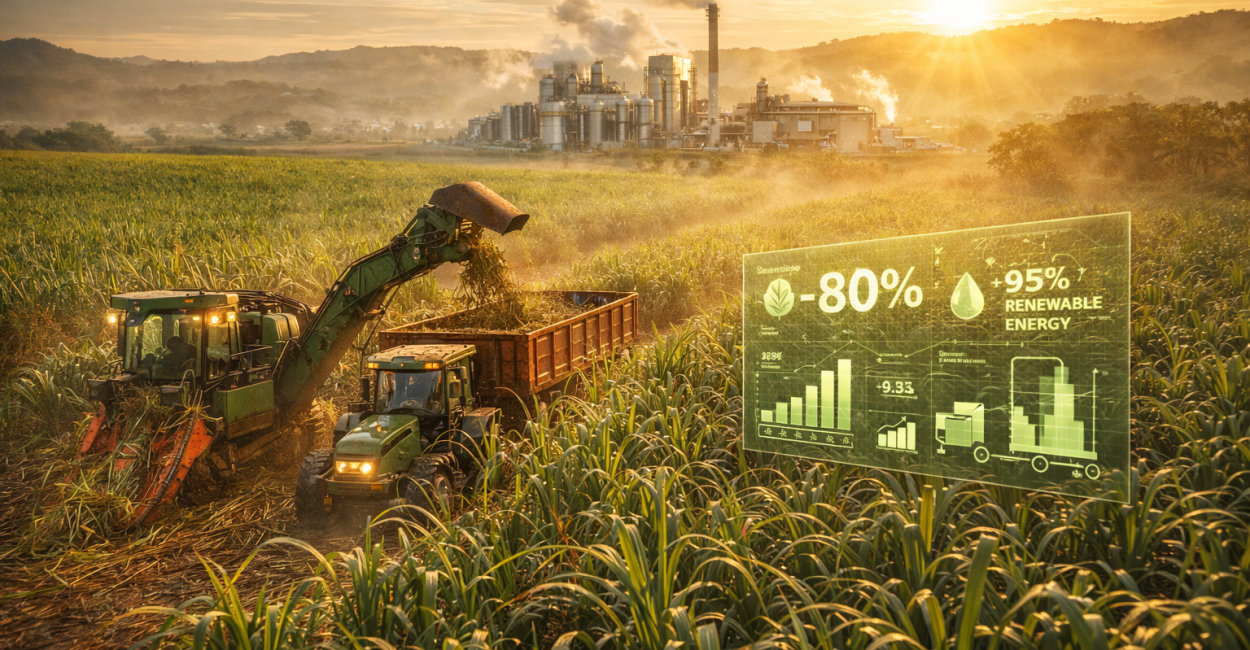
The significance of Sugarcane Ethanol is growing as nations seek practical paths to decarbonize transport. Sugarcane ethanol offers a proven, low-carbon alternative to gasoline and a scalable bridge for the global energy transition.
While electric vehicles attract headlines, biofuels remain essential for hard-to-electrify sectors. This article explains why Brazil’s Sugarcane Ethanol—built over 50 years—delivers dramatic emissions cuts and how it can reshape global fuel markets.
Keep reading to discover why sugarcane ethanol could be the game-changer the energy transition desperately needs and how its environmental profile compares to corn ethanol and other feedstocks.
Global Energy Transition and the Role of Sugarcane Ethanol
Decarbonizing Transport with Biofuels
Global pressure to decarbonize transport is immediate and multifaceted: cities demand cleaner air, regulators tighten emissions targets, and fleets seek low-carbon fuels. Sugarcane Ethanol provides a pragmatic option because it integrates with existing transport infrastructure and internal combustion engines, lowering lifecycle greenhouse gas emissions significantly compared to gasoline.
Biofuels act as a transitional technology for heavy transport, shipping, and aviation where batteries remain constrained. Sugarcane ethanol’s energy density and compatibility with flex-fuel systems mean rapid deployment with existing vehicles and fuel stations.
For policymakers and fleet managers, sugarcane-based fuels offer measurable emissions reductions today while advanced solutions scale up.
Limits of Electrification and Why Fuels Still Matter
Electric vehicles are critical but partial: battery production depends on mining, grid upgrades, and significant capital. For long-haul, aviation, and some industrial uses, batteries are not yet viable at scale. Sugarcane Ethanol can fill these gaps by supplying low-carbon liquid fuels.
Moreover, grid constraints in many regions slow EV adoption, whereas ethanol leverages established fuel distribution networks. This makes sugarcane ethanol a practical complement to electrification rather than a competitor.
Understanding these limits clarifies why diversified decarbonization strategies—including sugarcane ethanol—are prudent.
Why the Debate Centers on Corn Ethanol, Not Sugarcane
Political narratives and domestic agricultural interests, particularly in the U.S. corn belt, have pushed corn ethanol to the center of global discussions. That has skewed perceptions, equating “ethanol” with the higher-impact American model rather than the low-carbon Brazilian alternative.
Consequently, many policymakers and consumers assume all ethanol performs similarly, overlooking sugarcane’s superior lifecycle profile. This misperception delays wider adoption of best-performing biofuels such as sugarcane ethanol.
Addressing this narrative imbalance is crucial for effective, climate-smart fuel policy worldwide.
Brazil’s 50-year Lead in Sugarcane Ethanol
Origins of Proálcool and Industry Scale
The Proálcool program, launched in 1975, was Brazil’s strategic response to oil shocks and set the country on a distinct biofuel path. Over five decades, Brazil developed one of the world’s most efficient ethanol industries with integrated mills, strong logistics, and a consumer market adapted to biofuel use.
Investment in research, agronomy, and engine compatibility (flex-fuel technology) created economies of scale that drove down costs and improved environmental performance. The result is an industry optimized for both sugar and fuel outputs.
Brazil’s head start means operational know-how and institutional capacity that newer producers can learn from.
Industrial Integration and Flex-fuel Adoption
- Widespread flex-fuel vehicle fleet—~80% of new cars compatible with ethanol
- Network of ethanol-capable fuel stations nationwide
- Integrated mills producing ethanol, sugar, and power
- Logistics chains tailored to bulk biofuel distribution
- Policy frameworks supporting market stability
Those components make market uptake fast and resilient compared with ad hoc adoption elsewhere, ensuring consistent domestic demand and stable investment signals.
Flex-fuel vehicle penetration transforms consumer behavior and creates reliable demand drivers for sustainable ethanol production.
Current Production and Global Position
Today Brazil is the world’s second-largest ethanol producer after the U.S., but unlike U.S. output—heavily corn-based—Brazilian ethanol comes primarily from sugarcane. This distinction drives much of the lifecycle emissions performance gap.
Brazil combines high yields per hectare, efficient processing, and co-generation of electricity from bagasse, which lowers net energy inputs. Export potential has expanded as global markets seek low-carbon liquid fuels.
These strengths position Brazil as a strategic supplier for decarbonizing international transport sectors.
| Metric | Brazil (Sugarcane Ethanol) |
|---|---|
| Industry age | ~50 years (Proálcool since 1975) |
| Flex-fuel vehicle share | ~80% of new cars |
Environmental Performance and Lifecycle Wins of Sugarcane Ethanol
Carbon Footprint and Greenhouse Gas Reductions
Sugarcane Ethanol reduces lifecycle greenhouse gas emissions by up to 90% compared to gasoline in Brazilian conditions. This dramatic reduction stems from rapid regrowth capturing CO2, high processing efficiency, and the use of bagasse for on-site power generation.
By contrast, corn ethanol typically cuts emissions by only 20–40% depending on assumptions. The sugarcane carbon cycle—from photosynthesis in the field to combustion in engines—creates a much lower net carbon footprint when land-use change is avoided.
International LCA studies and certifications (e.g., RenovaBio, ISCC) corroborate these differences, making sugarcane ethanol one of the best-performing commercial biofuels.
Water Use, Reuse, and Efficiency
Water efficiency in Brazilian mills has improved significantly: modern plants capture and reuse process water, treat effluents like vinasse, and employ drip irrigation where needed. The net freshwater footprint is moderate relative to many row crops when considering regional rainfall patterns.
Vinhaça recycling is critical: treated vinasse returns nutrients to fields, reducing fertilizer demand and lowering water contamination risks. Combined with irrigation management, these practices reduce the sector’s overall water intensity.
Compared to irrigated corn or other energy crops, sugarcane’s water profile is more favorable in Brazil’s tropical-growing regions.
Land Use, Zoning, and Avoiding Food Competition
Concerns that sugarcane displaces food crops are mitigated in Brazil by agroecological zoning and a history of expansion largely onto degraded pastures, not native forests. National policies and monitoring aim to prevent deforestation-driven feedstock expansion.
Brazil’s land-use dynamics show that yield increases and better land management, rather than frontier expansion, have supported ethanol growth. This reduces indirect land-use change risks when governance and certification are enforced.
Thus, sugarcane ethanol can grow without directly competing with staple food production when guided by sound policy and territorial planning.
Advanced Sustainability: Circular Production and SAF Potential
Zero-waste Processes and Co-products
Brazilian mills embody a near zero-waste model: bagasse generates electricity and heat, vinasse returns nutrients to fields, and surplus power can be sold to the grid. This circular approach improves energy balance and reduces reliance on external inputs.
Emerging uses for cane straw and elaborated vinasse processing can further add value and reduce environmental footprints. Co-products—sugar, electricity, fertilizer substitution—make the industry resilient and multipurpose.
These integrated systems are central to sugarcane ethanol’s superior sustainability indicators.
Lifecycle Analysis and International Certifications
| Assessment | Outcome |
|---|---|
| LCA (Brazilian sugarcane) | Up to 90% GHG reduction vs gasoline |
| Certifications | RenovaBio, ISCC, Bonsucro compliance possible |
International certification schemes validate sustainable practices and open access to European and other markets. RenovaBio provides a domestic framework linking production to carbon credits, while ISCC and Bonsucro facilitate export credibility.
Clear LCA methodologies combined with certification reduce market barriers for low-carbon sugarcane ethanol.
From Ethanol to Sustainable Aviation Fuel (SAF)
Sugarcane ethanol is a promising feedstock for ethanol-to-jet SAF pathways, which convert alcohol into sustainable aviation kerosene. SAF demand is projected to surge, and Brazil’s ethanol industry is well placed to supply low-carbon feedstock at scale.
With dedicated investment and certification pipelines, sugarcane-based SAF could deliver immediate lifecycle emissions reductions for aviation compared to fossil jet fuel. This aligns with airline decarbonization targets and global SAF mandates.
Brazilian producers and policymakers are increasingly positioning the sector to capture this high-value market opportunity.
Sugarcane Ethanol Versus Corn Ethanol: An Honest Comparison
Direct Comparison of Environmental and Technical Metrics
- GHG reductions: sugarcane far outperforms corn in most LCAs
- Energy balance: sugarcane delivers higher net energy yield
- Water and land impacts: corn often requires more irrigation and competes more with food
- Byproduct utilization: sugarcane uses bagasse and vinasse comprehensively
These contrasts explain why, despite corn ethanol’s political prominence, sugarcane ethanol is the superior environmental choice where agroclimatic and governance conditions allow it. The energy return on investment and co-product valorization are decisive advantages.
Clear communication of these metrics can shift procurement decisions toward low-carbon sugarcane fuels globally.
Economic and Political Reasons Corn Ethanol Dominates
Corn ethanol’s political dominance, especially in the U.S., stems from domestic agricultural policy, subsidy structures, and lobby power. These factors shape mandates and public narratives, often sidelining international comparative performance.
Trade barriers and tariff policies also protect domestic industries, limiting imports of more efficient ethanol even when climate benefits would favor them. Changing this requires diplomatic negotiation and evidence-based policy reform.
Recognizing these drivers helps explain current market distortions and points to pathways for opening markets to sugarcane ethanol.
Implications for Global Fuel Policy and Procurement
Procurement strategies that prioritize lifecycle emissions and certified sustainability could accelerate adoption of sugarcane ethanol imports. Governments and corporations seeking rapid carbon reductions should evaluate feedstock origin and LCA outcomes rather than treating all ethanol equally.
Public tenders, fuel mandates, and corporate sourcing policies updated to reflect true environmental performance would create demand signals for Brazilian sugarcane ethanol and SAF.
Policy alignment across trade and climate goals is central to unlocking the fuel’s global potential.
Challenges, Critiques, and the Path Forward
Environmental Criticisms and Responses
Historically, sugarcane expansion was associated with burning fields and local pollution. Today, mechanical harvesting and strict regulation have largely eliminated routine burning. Environmental monitoring and certification further mitigate risks.
Continued focus on preventing deforestation, enforcing zoning, and improving soil management remains essential. Technology and governance have already reduced many legacy impacts, but vigilance is required to maintain credibility.
Transparent reporting and third-party audits help address legitimate environmental concerns.
Social and Labor Issues
Labor conditions in some mills and fields have been problematic historically; however, industry initiatives, stronger labor laws, and buyer-driven codes of conduct are improving standards. Social certification and audits are increasingly common among export-oriented producers.
Investments in worker housing, mechanization, and training improve livelihoods while reducing manual labor intensity. Still, continued oversight and enforcement are necessary to ensure equitable benefits across supply chains.
Engagement with unions, communities, and NGOs supports long-term social sustainability.
Climate Risks, Price Volatility, and Resilience
Sugarcane production is weather-dependent; droughts or atypical frost events can affect yields. Diversified operations, irrigation where appropriate, and improved genetics increase resilience. Market volatility tied to oil prices also impacts competitiveness.
The industry mitigates risk through co-products (power, sugar), long-term contracts, and export diversification. Policy tools like RenovaBio help internalize carbon value and stabilize demand for low-carbon ethanol.
Strategic planning and investment in adaptation are essential to sustain long-term growth.
Conclusion
Brazil’s Sugarcane Ethanol combines five decades of industrial experience, strong lifecycle emissions performance, and integrated production systems to deliver one of the cleanest commercial liquid fuels available. Its advantages—high GHG reductions, efficient resource use, and expanding SAF potential—make it a vital piece of the global decarbonization puzzle.
Do you think sugarcane ethanol deserves more attention in the global energy debate? Leave your comment below.
FAQ
What is Sugarcane Ethanol and How Does It Differ from Other Biofuels?
Sugarcane ethanol is a biofuel produced by fermenting sugars extracted from sugarcane. Unlike corn ethanol, which uses starch, sugarcane ethanol has a higher energy balance and typically much lower lifecycle greenhouse gas emissions. Efficient processing, bagasse co-generation, and tropical growth conditions give sugarcane ethanol superior environmental metrics.
How Much Can Sugarcane Ethanol Reduce Greenhouse Gas Emissions?
Under typical Brazilian production practices, sugarcane ethanol can reduce lifecycle greenhouse gas emissions by up to 90% compared to gasoline. This depends on factors like land-use change, milling efficiency, and co-generation of electricity with bagasse. Certified sustainable production is key to achieving top reductions.
Does Sugarcane Ethanol Compete with Food Production?
In Brazil, sugarcane expansion has largely occurred on degraded pastures and within zoned agricultural areas, minimizing direct competition with food crops. Strong land-use governance and yield improvements further limit food displacement risks when policies and monitoring are enforced.
Can Sugarcane Ethanol Be Used for Aviation Fuels (SAF)?
Yes. Sugarcane ethanol can be converted into Sustainable Aviation Fuel via alcohol-to-jet pathways. This offers substantial lifecycle emissions reductions for aviation. Brazil’s abundant low-carbon ethanol makes it a promising feedstock supplier for emerging SAF markets if investments and certification systems scale accordingly.
What Are the Main Challenges Brazil Must Address to Expand Exports?
Key challenges include maintaining robust social and environmental governance, preventing indirect land-use change, improving logistics for export scaling, and negotiating trade barriers. Continued certification, transparent reporting, and diplomatic efforts to reduce tariffs are essential for market expansion.
Sources: IEA – Biofuels for Transport, RenovaBio, Bonsucro