Skip to content
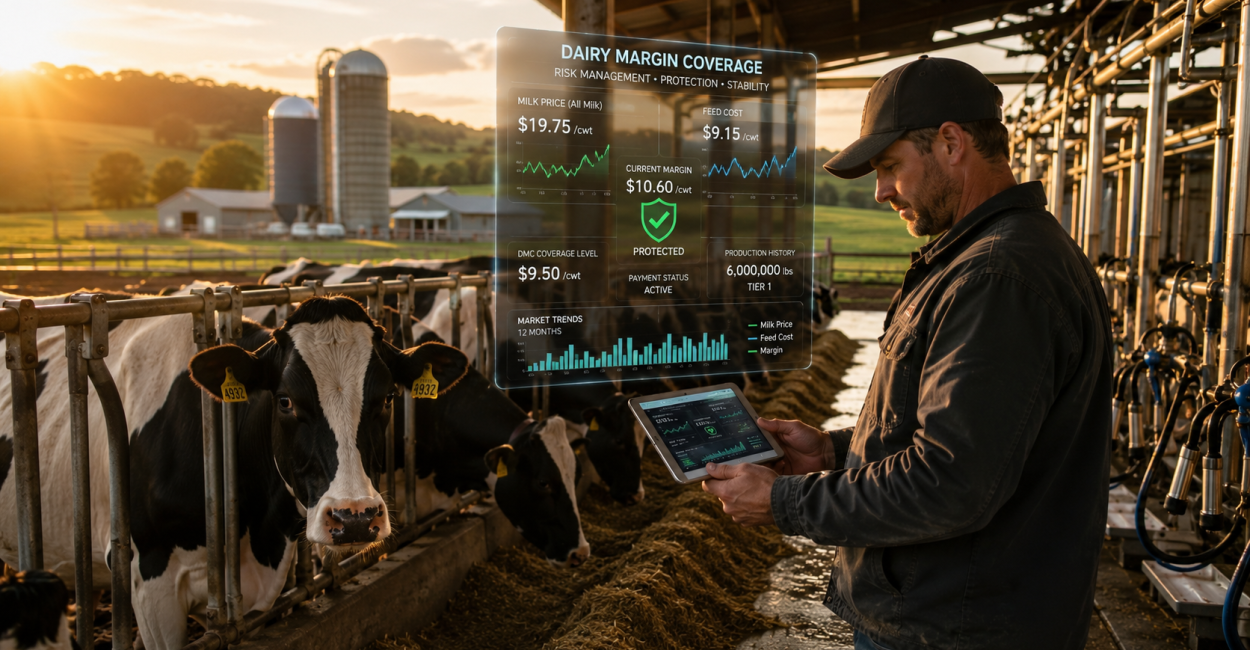
Dairy Margin Coverage (DMC) remains a crucial risk management tool for dairy farmers navigating volatile milk prices and rising feed costs. As we approach 2026, understanding how this federal program works, what it pays out, and recent legislative changes is more important than ever. Despite a paradox in 2025 when milk prices dropped significantly but DMC payments remained minimal, the program continues to offer valuable protection — especially for small to medium-sized operations.
In this article, we’ll demystify the mechanics of Dairy Margin Coverage, review its payment history from 2019 through 2025, and explore the major updates brought by the One Big Beautiful Bill Act (OBBBA) in 2026. Whether you’re new to DMC or reconsidering your coverage options, this guide offers a clear decision framework and highlights when DMC is the right choice — and when it might need to be paired with other tools for full protection.
How Dairy Margin Coverage Works — Understanding the Margin Formula
Key Components of the DMC Margin Calculation
- All-milk price (national average per cwt)
- Standardized feed cost based on national commodity prices
- Feed ingredients: corn, soybean meal, and premium alfalfa
- Margin = All-milk price − Standard feed cost
- Payments triggered when margin falls below chosen coverage level
Standardized Feed Cost Formula and Its Implications
The feed cost in DMC is calculated using fixed coefficients: 1.0728 bushels of corn, 0.00735 tons of soybean meal, and 0.0137 tons of premium alfalfa, all priced at national averages from NASS data. This reflects a standardized ration to produce 100 pounds (1 cwt) of milk. While this simplifies pricing, it excludes the actual costs farmers incur, especially if they grow their own feed.
What DMC Does Not Cover — Key Structural Limitations
DMC’s margin formula does not account for the cost of producing feed on-farm, including inputs like seed, fertilizer, or fuel. Additionally, rising non-feed costs such as labor, veterinary services, and energy are not reflected. Therefore, the margin may overstate profitability for some producers, particularly those in regions with higher feed costs or significant non-feed expenses.
What Changed in 2026 Under the One Big Beautiful Bill Act (OBBBA)
Notable Updates Affecting Dairy Margin Coverage
- Tier 1 coverage expanded from 5 to 6 million pounds
- Production history updated to highest milk marketings from 2021–2023
- Six-year lock-in option introduced with a 25% premium discount
- Program reauthorized through 2031, providing long-term certainty
Comparing 2025 And 2026 DMC Features
| Feature | 2025 | 2026 |
|---|---|---|
| Tier 1 Coverage Limit | 5 million lbs | 6 million lbs |
| Production History Base | 2011–2013 | 2021–2023 |
| Lock-in Option | Not available | 2026–2031 with 25% discount |
| Reauthorization Term | Annual | Through 2031 |
What the Changes Mean in Practice
Expanding Tier 1 coverage benefits mid-sized farms by allowing more production at lower premium rates. The updated production history reflects growth trends, enabling higher insured volumes. The lock-in option offers premium savings and long-term coverage stability, appealing to producers committed to dairy farming over multiple years.
Premium Costs — What You Actually Pay Per Hundredweight
Understanding DMC Premium Rate Structure
- Tier 1 premiums apply to first 6 million pounds (2026)
- Premiums vary by coverage level from $4.00 to $9.50 per cwt margin
- Tier 2 premiums apply above 6 million pounds with higher rates
- Lock-in option reduces premiums by 25%
- Catastrophic coverage at $4.00 margin level has no premium
Detailed 2026 Tier 1 Premium Rates
| Coverage Level ($/cwt) | Annual Premium ($/cwt) | Lock-in Premium ($/cwt) |
|---|---|---|
| $4.00 (catastrophic) | $0.00 | $0.00 |
| $5.00 | $0.025 | $0.019 |
| $7.00 | $0.217 | $0.163 |
| $9.50 | $0.150 | $0.1125 |
Example Premium Costs for Typical Dairy Farms
A 500-cow operation producing 12 million pounds annually might pay about $58,800 yearly for maximum coverage, with a $14,670 premium discount if locking in for six years. For a smaller farm producing 1 million pounds, the premium at the $9.50 coverage level is only $150 annually, offering excellent value for risk protection.
Historical Payments — What DMC Delivered from 2019 To 2025
Frequency and Magnitude of Payments
- Payments triggered in 38 of 72 months at $9.50 coverage (53%)
- Overall payments from 2018 to 2024 occurred 66.67% of the time
- Average payment about $1.49 per cwt before premiums
- Net average payment after premiums roughly $1.35 per cwt
- Over $2.7 billion in net support since 2019
Year-by-year Highlights
2019 saw limited payments as the program was new. 2020 experienced large payments due to COVID-19 price shocks. 2021 and 2023 each exceeded $1 billion in payments amid volatile feed and milk prices. 2024 showed partial recovery, and 2025 had few payments due to relatively strong margins despite milk price drops.
Projected 2026 Payments and Insights
Projections suggest early 2026 margins below $9.50 would trigger payments for January and February, totaling over $2,000 per million pounds after premiums. This highlights DMC’s value in smoothing margin volatility. However, producers should consider sustained periods of low margins rather than isolated months when evaluating coverage.

Comparing DMC with Other Dairy Risk Management Tools
Key Differences Between DMC, LGM-Dairy, and Dairy Revenue Protection
- DMC: federal program via FSA, covers national margin, automatic monthly payments
- LGM-Dairy: crop insurance via RMA, customizable coverage periods and margins
- Dairy Revenue Protection: crop insurance via RMA, protects milk price only
- DMC best for baseline margin protection and smaller operations
- LGM and Dairy-RP suited for specific timing or regional pricing needs
Choosing the Right Program Based on Farm Profile
| Farm Type | Recommended Program(s) |
|---|---|
| Small/medium with stable feed costs | DMC Tier 1 |
| Operations needing timing customization | LGM-Dairy |
| Farms with fixed feed contracts | Dairy Revenue Protection |
How Stacking Programs Can Optimize Risk Management
Many producers benefit from combining DMC with LGM-Dairy or Dairy Revenue Protection, layering protections to cover both margin risks and revenue fluctuations. This strategy addresses DMC’s limitations by providing regional price sensitivity and feed cost variability coverage.
Enrollment Process — What You Need to Know for DMC
Steps to Enroll and Key Deadlines
- Complete application at local FSA office
- Enrollment period for 2026 was Jan 12–Feb 26, 2026 (now closed)
- Enrollment for 2027 expected to open January 2027
- Late or rollover enrollment may be available—contact USDA Service Center
- Submit milk marketing statements to establish production history
Documents Required for Application
Farmers must provide milk marketing statements from their highest production year between 2021 and 2023. New operations submit statements from their first year. The FSA application form is available at local Service Centers or online via farmers.gov. Choose coverage level, production percentage, and lock-in options during enrollment.
Important Considerations and Administrative Fees
An annual administrative fee of $100 applies, waived for beginning, limited resource, socially disadvantaged, or veteran farmers. Use the USDA DMC Decision Tool online to simulate payments and optimize your coverage choice based on your production history and risk tolerance.
Should You Enroll? A Practical Decision Framework
Reasons to Enroll at the $9.50 Tier 1 Level
- Low premium cost ($0.15/cwt) for up to 6 million pounds
- Strong historical payment frequency and amounts
- High return on investment projected even in moderate years
- Expanded coverage and updated production history improve eligibility
- Lock-in option provides premium discount and stability
When to Consider the Six-year Lock-in Option
The lock-in reduces premiums by 25%, guarantees coverage through 2031, and avoids annual enrollment hassle. It’s ideal for producers planning to stay in dairy farming long term who want predictable costs and protection against future downturns.
Situations Where DMC Might Not Be the Best Fit
If your feed costs are consistently higher than the national benchmark, as in some Northeastern states, the standardized DMC margin may not reflect your actual risks. In these cases, supplementing DMC with Dairy Revenue Protection or LGM-Dairy that use regional prices can provide more tailored coverage.
Conclusion
Dairy Margin Coverage remains a powerful, cost-effective risk management tool for dairy producers, especially those with up to 6 million pounds of milk production. The 2026 program updates make it more accessible and financially attractive than ever, providing long-term security amid market volatility.
While not perfect—particularly in capturing non-feed costs or regional price variation—DMC’s low premiums and solid payment history make it a smart baseline hedge. Dairy farmers should strongly consider enrolling or locking in coverage to protect their operations against unpredictable margin compression. Don’t leave this affordable safety net on the shelf.
Frequently Asked Questions
What is Dairy Margin Coverage (DMC)?
DMC is a federal risk management program administered by the Farm Service Agency (FSA) that protects dairy producers against declines in the national margin between milk prices and feed costs. It provides monthly payments when margins fall below a selected coverage level.
How is the DMC Margin Calculated?
The margin equals the national all-milk price per hundredweight minus a standardized feed cost based on fixed quantities of corn, soybean meal, and alfalfa priced at national averages. This formula simplifies feed costs but may not reflect all farm-specific expenses.
What Changed in DMC for 2026?
Key changes include expanding Tier 1 coverage from 5 to 6 million pounds, updating production history to 2021–2023, introducing a six-year lock-in with a 25% discount on premiums, and reauthorizing the program through 2031.
Can I Still Enroll in DMC for 2026?
The enrollment period for 2026 closed on February 26, 2026. Producers interested in 2027 coverage should prepare for enrollment starting in January 2027. Some local offices may allow late or rollover enrollment; contact your USDA Service Center promptly.
How Do I Decide Between DMC and Other Dairy Risk Tools?
Consider your farm size, feed cost variability, and risk tolerance. DMC is excellent for baseline margin protection, especially for smaller farms. LGM-Dairy and Dairy Revenue Protection offer more tailored coverage for specific periods or regional price risks. Combining programs can optimize overall protection.