
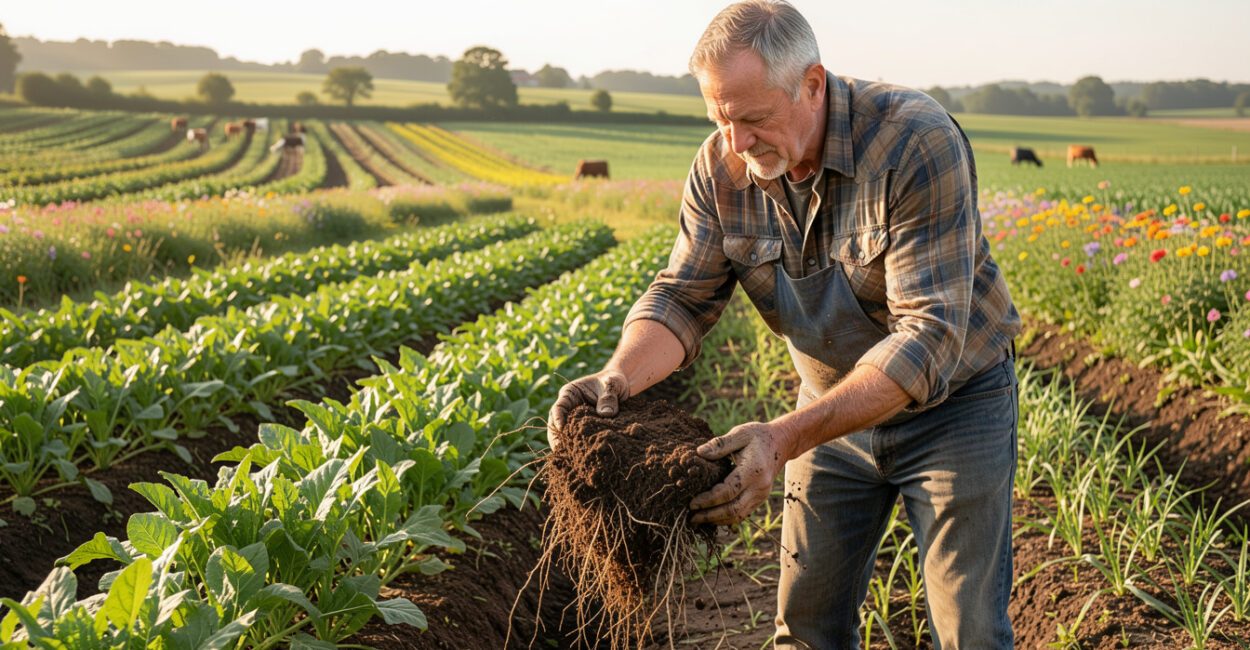
A field can look productive while losing topsoil, organic matter, and the ability to absorb heavy rain. Regenerative agriculture offers farmers a way to address those problems by managing soil, water, plants, and animals as connected parts of the farm. Its practices can improve soil health and resilience, but results depend on local conditions and how well each practice is managed.
There is no single official definition or universal checklist. The useful question is whether a farm can show measurable progress toward healthier soil, functioning ecosystems, and dependable production without shifting costs or damage elsewhere.
What is Regenerative Agriculture?
Regenerative agriculture is a farming approach that uses locally appropriate practices to restore or improve soil function and ecosystem processes while maintaining a viable farm business. In plain terms, it asks farmers to produce food while rebuilding the natural resources production depends on. The term has no universally accepted definition, and there is no single certification that covers every farm or production system.
That lack of a universal standard matters. A company may use “regenerative” to describe a specific practice, a whole-farm program, or a product supply chain. Those claims are easier to assess when they name the practices used, the outcomes measured, and the timeframe for reporting progress.
The USDA Natural Resources Conservation Service’s soil health guidance offers a useful technical foundation: soil health concerns the continued capacity of soil to function as a living ecosystem. Regenerative farming commonly builds on that idea, while also considering biodiversity, water stewardship, and the farm’s long-term ability to operate.
Why Farmers Focus on Soil, Water, and Biodiversity
Healthy soil supports root growth, nutrient cycling, and water movement. When soil is left bare or disturbed repeatedly, it can become more vulnerable to erosion, compaction, and runoff. Those problems may reduce a farm’s ability to withstand dry spells or intense rainfall, though the size and timing of any improvement vary by soil type and weather.
Biodiversity has a practical role, too. Diverse crop rotations and habitat areas can support beneficial insects and soil organisms, while well-managed pastures can distribute grazing pressure more evenly. The goal is not to maximize species counts for their own sake; it is to support ecological functions that fit the farm’s production needs.
Water stewardship means managing infiltration, runoff, and water use in ways suited to the watershed and operation. A cover crop can protect soil from raindrop impact, but in a dry region it may also use water needed by the next crop. That trade-off should be assessed before planting, not after a poor stand or a dry spring.
Regenerative outcomes depend on matching a practice to the farm’s limiting resource, then checking whether that resource actually improves.
The FAO’s 10 Elements of Agroecology provide a complementary framework for thinking about diversity, resource efficiency, resilience, and knowledge sharing. Agroecology and regenerative agriculture overlap, but they are not identical labels or formal standards.
Common Regenerative Agriculture Practices
Practices are tools, not proof of success. A farm may use one or several of these approaches, depending on its crops, livestock, climate, equipment, and business goals:
- Cover crops: Plants grown between cash crops or during otherwise bare periods to protect soil, capture nutrients, or add biomass. Species and termination timing matter; a poorly timed cover crop can compete for water or delay planting.
- Reduced tillage or no-till farming: Limiting soil disturbance can protect structure and reduce erosion. Weed control, residue management, and soil warming may become more challenging, and some farms still need occasional tillage.
- Crop rotation and diversification: Changing crop families and planting sequences can interrupt some pest cycles and vary rooting patterns and nutrient demands. Rotation design must still fit markets, equipment, and the local growing season.
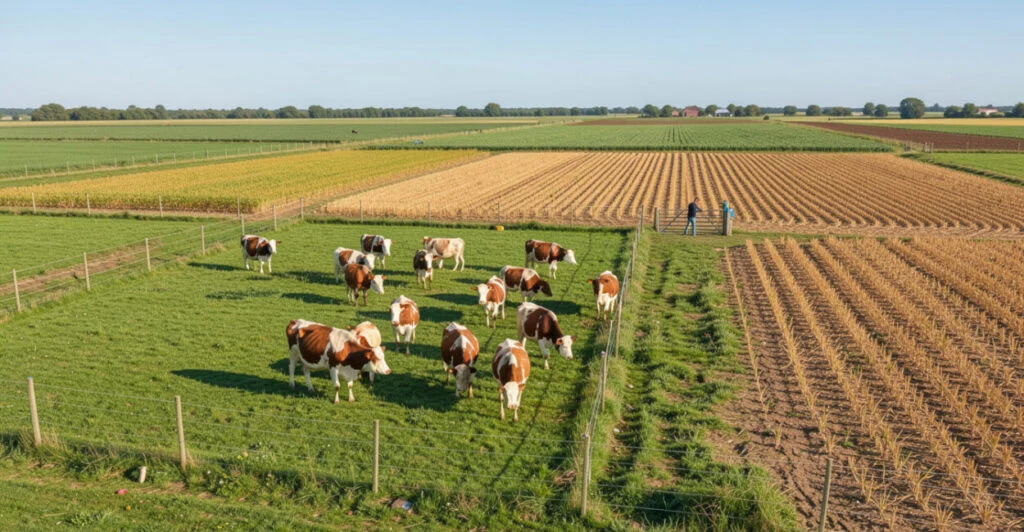
- Managed grazing: Adjusting livestock access, timing, and recovery periods can help avoid persistent overgrazing. Stocking rate and forage recovery matter more than a grazing schedule applied without regard to conditions.
- Compost, manure, or other organic amendments: These can return nutrients and organic matter to soil, but rates and timing need to account for nutrient content, runoff risk, and crop demand.
- Agroforestry and habitat features: Trees, hedgerows, or field margins can provide habitat and other benefits, though they require space, establishment costs, and management.
A frequent mistake is adopting no-till or cover crops as a complete system without planning for weeds, residue, water, and the next crop’s planting window. Those details are connected: for example, a cover crop that is terminated late may leave a strong mulch layer but also delay planting or deplete moisture. Start with the constraint the practice is meant to address, then plan the rest of the system around it.
How Practices Work on Different Farms
Regenerative agriculture can be used on both crop and livestock farms. On a crop farm, the focus may be keeping living roots in the soil, reducing erosion, or adjusting rotation. On a livestock operation, it may center on pasture recovery, forage diversity, and keeping animals distributed across the land without exceeding its capacity.
There is no universal recipe. A cover crop that fits a humid, long-season region may be a poor choice where water is scarce or the cash crop needs an early planting date. Similarly, reducing tillage can work well where residue and weed control are manageable, but it may require a different equipment setup or a revised pest strategy.
Practice Intended outcome Key limitation Cover crops Protect soil, add living roots, and capture nutrients Can compete for water or interfere with planting if timing is off Reduced tillage or no-till Limit soil disturbance and erosion May complicate weed control, residue handling, or soil warming Crop rotation Vary crop demands and disrupt some pest cycles Must fit local markets, equipment, and growing conditions Managed grazing Give forage time to recover and avoid chronic overuse Requires attention to stocking rate, weather, and pasture condition Agroforestry Add trees or woody vegetation for habitat and other farm functions Needs land, time, establishment investment, and ongoing care
Consider a row-crop farm with runoff after intense storms. The operator could first map where water concentrates, then compare those areas with soil tests and field observations. A cover crop or reduced tillage might help, but the choice should account for the following crop’s planting date and available soil moisture. The farm can track ground cover, erosion signs, and crop performance over several seasons rather than judging the change from one field walk.
For farms managing transition costs or climate exposure, it can also help to review financing options for agribusiness resilience and the practical considerations in local climate adaptation planning.
Potential Benefits and What the Evidence Can Support
Soil health can improve when practices increase living roots, reduce erosion, or add organic matter, but the response is not immediate or uniform. Soil carbon is particularly easy to overstate: it varies with depth, soil type, climate, and management history, and a change in a shallow sample does not automatically establish a durable increase across the whole field.
Water outcomes depend on the specific problem. Better soil structure may support infiltration and reduce runoff in some settings, while a cover crop can consume water during a dry period. Biodiversity outcomes also vary: a diverse rotation or habitat strip may support more organisms, but one practice alone does not establish that the entire farm ecosystem has improved.
Climate benefits can come from reduced fuel use, lower emissions, or increased soil carbon, depending on the system. None is guaranteed by adopting a label or practice. The National Academies’ Science Breakthroughs to Advance Food and Agricultural Research by 2030 highlights the need for better measurement and agricultural research; farm-level claims should likewise specify what was measured and how.
Economic outcomes can improve if a practice reduces input use, prevents soil loss, or stabilizes production. They can also worsen during transition because of seed, equipment, labor, or learning costs. Yield effects vary by crop, weather, management, and the length of the transition, so a farm should assess net returns as well as yield.
A credible claim describes both the intended benefit and the conditions under which it may not occur.
For livestock producers, the relationship between pasture management and business performance is explored further in this overview of sustainable livestock farming strategies.
Trade-Offs, Measurement, and Credible Claims
Transition costs can include new seed or fencing, different machinery, extra labor, and temporary yield changes. Some changes are modest; others require redesigning rotations, grazing plans, or marketing arrangements. Before expanding across the whole operation, many farms can reduce risk by testing a practice on a manageable field or pasture and comparing it with a similar area under existing management.
Soil health changes often take multiple seasons to evaluate, and some indicators respond sooner than others. Ground cover and visible erosion can be checked during a season; soil organic matter or soil carbon trends require careful sampling over time. A single test is a baseline, not proof of a trend.
Choose measurements that match the goal. For erosion, record bare ground and runoff locations. For soil structure, use consistent field assessments and sampling methods. For economics, compare input costs, labor, yield, and revenue across comparable fields, while noting weather and crop differences. The NRCS soil health framework can help identify relevant indicators, but no single test captures every soil function.
Consumers can assess regenerative claims by looking for clear answers to four questions: What practices are required? What outcomes are measured? Who verifies the information? What happens if the farm does not meet the stated standard? A label may offer useful rules, but the word “regenerative” alone does not tell a shopper what was done or independently confirmed.
Does regenerative agriculture always reduce yields or increase food prices? No. Yield and price effects depend on the production system, transition costs, local conditions, and how products are marketed. A practice may lower some costs after adaptation, but that outcome is not assured, and farmers may absorb costs rather than pass them on to consumers.
How It Differs from Sustainable and Organic Farming
Sustainable agriculture is a broad concept concerned with maintaining production and environmental, economic, and social viability over time. Organic farming is governed by specific production rules and certification requirements in markets such as the United States. Regenerative agriculture generally emphasizes improving ecological function, especially soil health, but the term itself does not have one universal legal definition.
These approaches can overlap. An organic farm may use cover crops and crop rotation to build soil health; a regenerative farm may use practices that do not meet organic rules. A sustainable operation may prioritize long-term viability without using “regenerative” as a label. The right comparison is between the actual standards and practices, not just the words on a package.
For growers deciding where to start, identify the farm’s clearest constraint first: erosion, declining soil structure, water stress, pasture recovery, or input costs. Select one practice that addresses it, define a baseline, and track both ecological indicators and operating results before scaling up.
📱 See this content as a Web Story
Frequently Asked Questions
How Long Does It Take for Regenerative Practices to Affect Soil Health?
Some visible indicators, such as ground cover or runoff, can change within a season. Soil structure and organic matter trends generally need consistent management and repeated measurements over multiple seasons, with timing shaped by soil and climate.
Is There a Single Regenerative Agriculture Certification?
No single certification is accepted universally. Programs may define their own requirements, so check the standard’s rules, verification process, and measures rather than relying on the label alone.
Can a Small Farm Use These Practices?
Yes. Practices can be adapted to a small operation, though labor, equipment, and market access may shape what is practical. A grower might begin with a rotation adjustment or a small cover-crop trial rather than invest in a farm-wide change.
Does Regenerative Farming Require Expensive Equipment?
Not always. Some practices require specialized equipment or infrastructure, while others can be adopted with existing tools or through custom services. Costs depend on the practice and the farm’s starting point.
What Should a Farm Record During a Trial?
Record the field or pasture location, practice and timing, weather conditions, inputs, labor, and production results. Add a few indicators tied to the goal, such as ground cover or erosion observations, and use consistent methods so the comparison remains meaningful.