
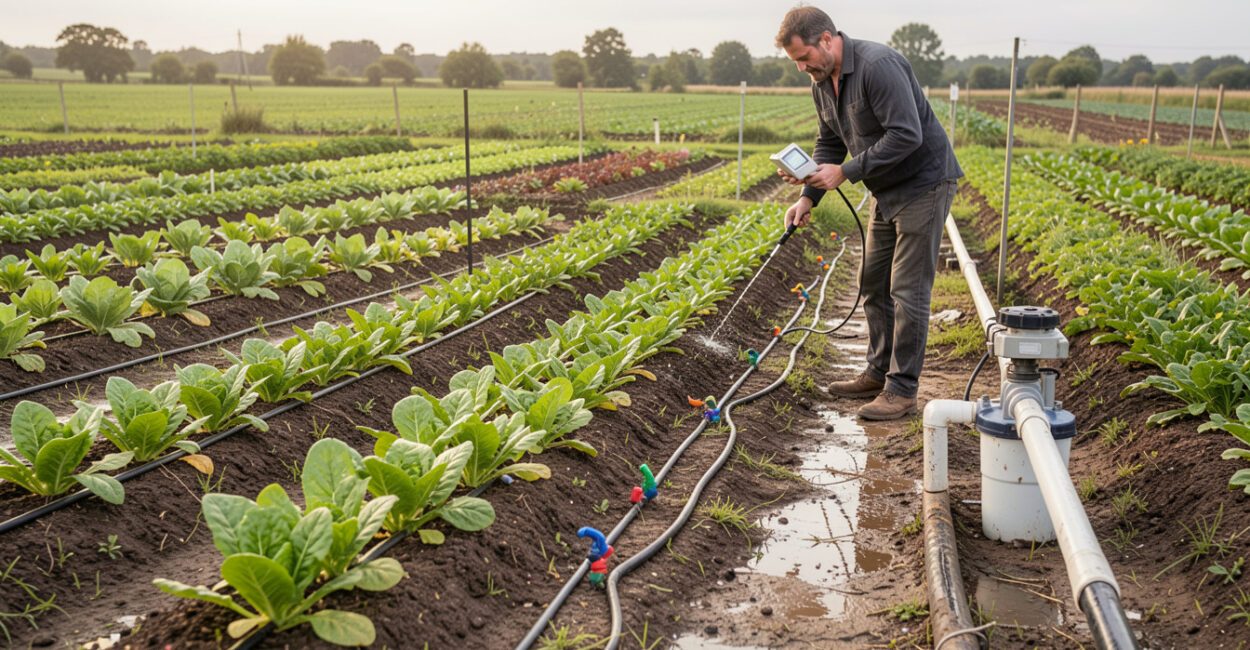
A field can lose water before a crop ever gets the chance to use it: to runoff, evaporation, leaks, or deep drainage below the roots. Sustainable Irrigation Systems reduce those losses by matching water delivery to soil, plants, weather, and the available supply. The right choice depends on the site; a high-tech controller cannot compensate for poor design or clogged emitters.
For a small garden, that may mean a well-zoned drip line and a rain barrel. For a farm, it may involve pressure-managed micro-irrigation, soil-moisture monitoring, or better scheduling of existing equipment. The first step is to find out where water is going now.
At a Glance
- Core principle: Apply water when and where plants can use it.
- Common options: Drip, micro-sprinkler, subsurface, rainwater-fed, and smart-controlled systems.
- Key design factors: Crop or plant needs, soil, climate, water source, pressure, and filtration.
- Useful performance measure: Water applied per unit of irrigated area, tracked over time.
- First practical step: Check the system’s flow and distribution before investing in upgrades.
What Sustainable Irrigation Systems Do
Sustainable irrigation is the planned application of water to meet plant needs while limiting avoidable losses and considering the source’s long-term availability. In plain terms, it means delivering the right amount to the active root zone, at a useful time, with as little runoff, evaporation, leakage, and deep drainage as the site allows.
Efficiency describes how well an irrigation system delivers water to its intended use; it does not prove that the overall water supply is sustainable. A highly efficient system can still draw too much from a stressed aquifer or river. The USDA Natural Resources Conservation Service guidance on irrigation water management emphasizes planning around water needs, system operation, and available resources.
That distinction matters in dry regions, where improved application efficiency may reduce withdrawals, but it may also allow more land to be irrigated unless water use is managed at the basin or farm level. Water-efficient irrigation supports broader soil-health and regenerative agriculture practices, but it cannot replace sound water allocation or local restrictions.
Benefits, Trade-Offs, and the Limits of Efficiency
Better targeting can reduce water wasted to wind drift, surface runoff, or wetting soil beyond the root zone. It can also help keep foliage dry, which may reduce conditions favorable to some plant diseases. The result depends on crop, climate, soil, and how the system is operated.
Drip and subsurface systems often require filtration, pressure regulation, and careful inspection. Their small outlets can clog, and a leak underground may be harder to spot than a broken sprinkler head. Pumps and controllers also use energy, so a water-saving upgrade can raise electricity demand if it requires more pressure or longer operating times.
A common mistake is to install drip tubing and assume the job is done. If zones are too long, pressure varies, or filters clog, plants at the end of a line may receive less water than those near the valve. Check distribution at multiple points before changing schedules; otherwise, extra run time can overwater the whole zone to compensate for a local problem.
Water efficiency also has limits when the source is unreliable or restricted. Check local rules and the source’s sustainable yield before expanding irrigated acreage. Farm-level planning can sit alongside climate adaptation measures for changing rainfall and heat, but it does not guarantee water will be available during a drought.
Comparing Sustainable Irrigation System Types
No single method suits every crop or site. The table compares typical strengths and constraints; actual performance depends on design, installation, operation, and maintenance.
| System | Water delivery | Often suits | Key constraint |
|---|---|---|---|
| Drip irrigation | Low-flow emitters apply water near plants or crop rows. | Row crops, orchards, vegetable beds, and landscaped beds. | Needs filtration and checks for clogging, leaks, and uneven pressure. |
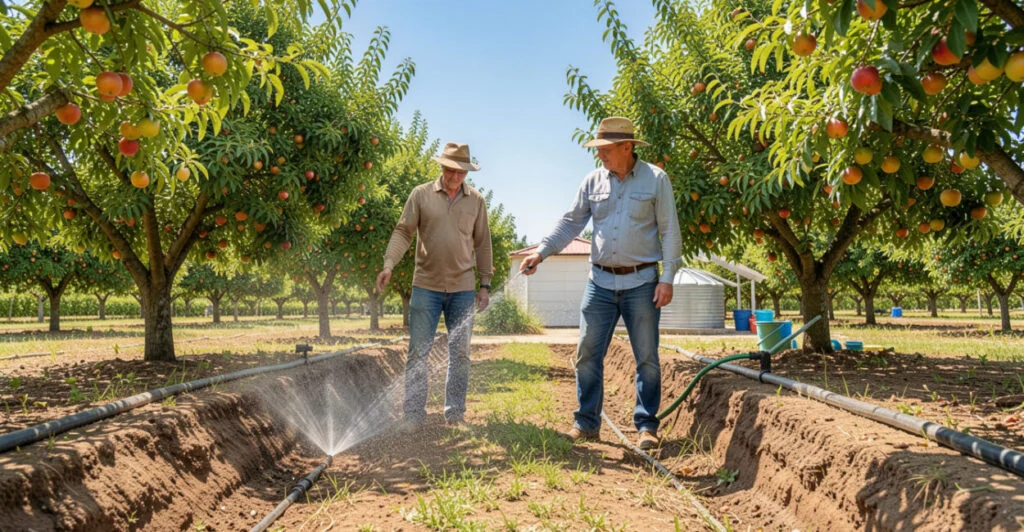
| Micro-sprinkler | Small sprinklers wet a defined area around plants. | Orchards, nurseries, and crops that benefit from a wider wetted zone. | Wind and evaporation can affect coverage; layout matters. |
| Rainwater-fed irrigation | Stored roof or surface runoff supplies an irrigation system. | Gardens and other sites with suitable catchment and storage. | Supply varies with rainfall and tank capacity; stored water may need screening or filtration. |
| Subsurface irrigation | Buried dripline or emitters deliver water below the soil surface. | Sites where surface evaporation or interference with field operations is a concern. | Leaks and blockages are harder to see; root intrusion and installation depth need attention. |
| Smart irrigation systems | Controllers adjust schedules using weather data, soil sensors, or both. | Gardens, landscapes, and farms where schedules need frequent adjustment. | Sensors must be placed and calibrated well; automation cannot fix poor hydraulics. |
Which Irrigation System Uses the Least Water?
Drip or subsurface drip can use the least water when crops are arranged in rows or beds, the system is well designed, and maintenance keeps delivery uniform. There is no universal winner: a micro-sprinkler may fit an orchard better, while rainwater collection can reduce demand on another source without changing how efficiently water reaches the roots.
For gardens, smart controllers can skip or shorten watering after rain. The EPA WaterSense guidance on labeled irrigation controllers explains how weather-based and soil-moisture-based controllers adjust schedules. A controller helps only if its settings match the landscape and the system’s actual flow.
How to Choose by Crop, Soil, Climate, and Water Source
Start with the plant’s root pattern and the area that needs watering. A vegetable bed with closely spaced rows has different needs from scattered trees, pasture, or a lawn. Consider harvest operations, equipment access, and whether different crops need separate irrigation schedules.
Soil changes how quickly water moves and how often it should be applied. Sandy soil drains quickly, so short, more frequent applications may limit deep percolation. Clay holds water longer but can pond or run off when application is too fast. Loam generally falls between those behaviors, but compaction, slope, and soil structure can alter the result.
Climate affects both demand and losses. Wind can carry sprinkler water away from the target, while hot, dry weather increases evaporative demand. Rainfall timing matters as much as total rainfall: a rain gauge or weather station can help distinguish a useful soaking from a brief shower that barely reaches the root zone.
Then evaluate the source. A well, surface-water diversion, municipal supply, or rainwater tank each has different limits, costs, and rules. In places with water restrictions, confirm permitted watering times and source conditions before buying equipment. The FAO’s guidance on water management and water-use efficiency in agriculture provides a broader framework for matching agricultural water use to available resources.
Designing and Installing an Efficient System
A useful design starts with the water source and the plants, then works outward to pipes and controls. For a farm-scale project, a qualified irrigation designer or local conservation specialist can help check flow, pressure, and site constraints before equipment is ordered.
- Map the site: Mark crop rows or planting beds, slopes, soil differences, water access, and areas with different watering needs.
- Measure source capacity: Confirm available flow and pressure during the times irrigation will run. Do not size a system from the pump label alone.
- Create zones: Group plants with similar water needs and divide areas with different elevations, soils, or exposure into separate zones.
- Match components: Select emitters or sprinklers for the crop and layout, then size pipe and regulators to keep flow and pressure within equipment specifications.
- Plan filtration and flushing: Use filtration suited to the water source and emitter requirements. Include a way to flush lines, since sediment and biological growth can block small passages.
- Test before regular use: Run each zone, check for leaks and pressure problems, and compare output at the beginning and end of lines.
- Set a starting schedule: Use crop growth stage, soil moisture, and weather as inputs, then adjust after checking how deeply water has moved.
For a small garden, the same logic applies at a simpler scale: separate containers from beds, use a filter on a drip kit, and confirm that the farthest emitter still flows. A rain barrel can supplement watering, but it may not hold enough to carry a garden through a long dry spell.
Maintenance, Measurement, and Project Costs
Efficient equipment can drift out of tune. Build inspection into the season rather than waiting for visible plant stress, which may appear after water has already been wasted or roots have been damaged.
- Inspect filters, flush lines, and clean clogged emitters or sprinkler nozzles.
- Look for leaks, damaged tubing, blocked outlets, and wet patches between scheduled runs.
- Compare flow or catch-cup coverage across a zone when plants receive uneven water.
- Adjust schedules after rain, during heat waves, and as crops move through growth stages.
- Check soil moisture at root depth; surface appearance alone can be misleading.
- Before freezing weather, drain or winterize equipment according to its manufacturer’s instructions.
Soil-moisture sensors can show whether the root zone is drying, but placement matters. Put a sensor where it represents the crop and soil in that zone, not beside an emitter where it stays unusually wet. For fields with variable soil, one sensor may not represent the whole field.
Upfront costs depend on acreage, terrain, water source, filtration, pumps, controls, labor, and whether existing infrastructure can be reused. Compare bids by looking at the complete installed system, not just the price of tubing or a controller. Local conservation districts, state agencies, and utility programs may offer cost-share funding or rebates; eligibility and deadlines vary, so confirm current terms before assuming a project qualifies.
Track water use per irrigated area over time, along with yield or plant condition and energy use where relevant. For example, if a 1-acre zone receives 10,000 gallons during a measured irrigation period, its application is 10,000 gallons per acre for that period. That figure alone does not show whether the crop needed that amount; compare it with soil moisture, weather, crop stage, and previous periods.
📱 See this content as a Web Story
Frequently Asked Questions
Can a Drip System Run from a Rain Barrel?
Yes, if the barrel provides enough elevation or a suitable pump to meet the system’s pressure needs. Use filtration compatible with the emitters, and test flow at the farthest line before relying on it.
Do Soil-Moisture Sensors Work in Every Soil?
They can be used in many soil types, but readings depend on sensor type, placement, and calibration. In fields with varied soils, more than one monitoring location may be needed.
Can Irrigation Water Be Reused?
Some sites can reuse captured runoff or treated water, but suitability depends on water quality, crop, soil, and local regulations. Salts or other contaminants can build up in soil or affect plants, so test the water and check applicable rules first.
Should Irrigation Run at Night?
Night watering can reduce some evaporation, but long periods of wet foliage may increase disease risk for certain crops. Drip irrigation avoids much of that foliage wetting; for sprinklers, follow crop-specific guidance and local restrictions.
How Often Should Drip Filters Be Cleaned?
Check them often during early operation and whenever flow drops or pressure changes. The right cleaning interval depends on source-water quality and filter design, so follow the manufacturer’s instructions and inspect the filter rather than relying on a fixed calendar alone.
Are Irrigation Rebates Guaranteed?
No. Programs can change, and some require preapproval, specific equipment, or proof of water savings. Check the administering agency’s current rules before purchasing or installing equipment.