Skip to content
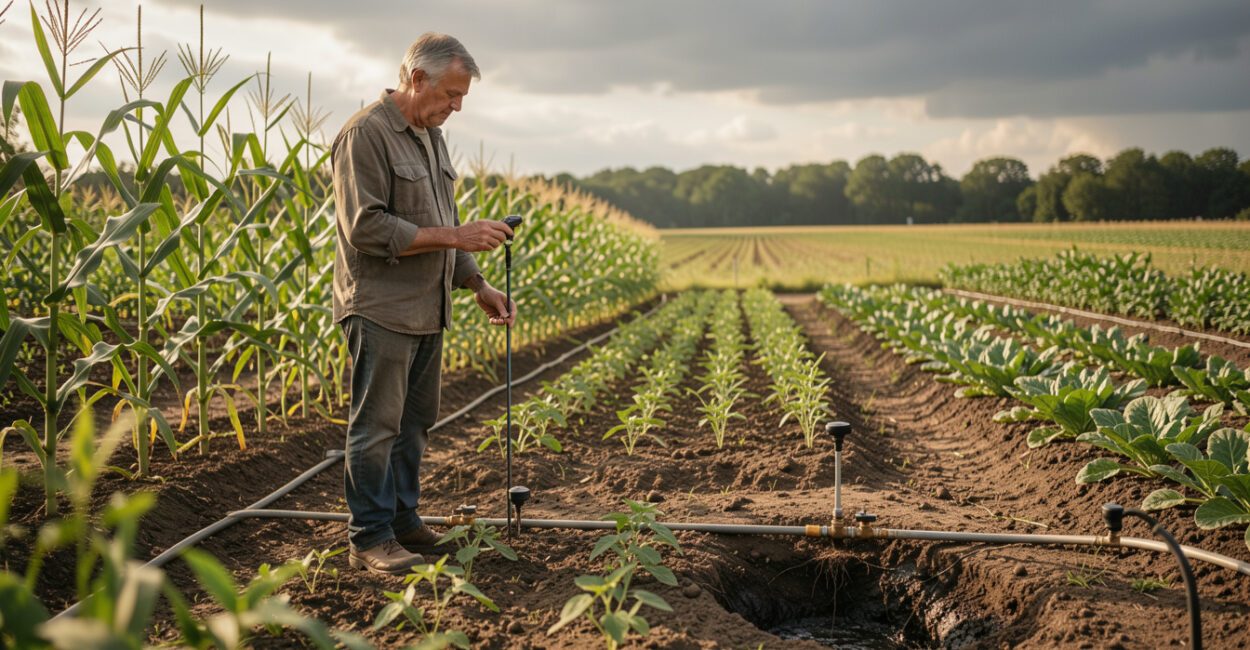
A soil sensor can show a wet root zone while a crop is already approaching a sensitive flowering period. That is why crop water scheduling needs to account for both what the soil holds and what the crop is doing. The best irrigation timing and frequency vary with crop, growth stage, rooting depth, soil, and near-term weather.
Sensor readings help growers decide when to irrigate and whether water is reaching the active roots. They work best as part of a field-specific plan, checked against rainfall, crop development, and the performance of the irrigation system. A single threshold or weekly routine rarely fits every field for an entire season.
What Does Crop Water Scheduling Mean for Different Crops?
Crop water scheduling is the planned timing and amount of irrigation used to meet a crop’s water demand while accounting for soil water availability, crop growth, and weather. In practice, it means using sensor readings and field observations to decide when to irrigate, how much to apply, and when to check again.
The goal is to keep enough water available in the crop’s active root zone without routinely pushing water below it. A reading from one depth cannot describe the whole root zone: a shallow sensor may respond quickly after irrigation, while a deeper one shows whether water has moved down to roots or is accumulating below them.
That distinction matters across crops. Shallow-rooted vegetables may need smaller, more frequent applications than established corn or cotton, while crops such as potatoes can be sensitive to swings in soil moisture during tuber development. The broader role of smart irrigation systems in farming is to support those field decisions, not replace crop-specific judgment.
How Do You Use Soil Moisture Sensors to Decide When to Irrigate?
Use sensors to track whether soil water in the active root zone is approaching a crop- and soil-specific lower limit, then irrigate enough to replenish that zone without saturating it. Interpret the reading alongside a second sensor depth, recent rain, crop stage, and the sensor’s calibration; a number alone is not a reliable trigger.
Growers commonly use either volumetric water content, which estimates the volume of water in a volume of soil, or soil water tension, which indicates how tightly the soil holds water. These measurements are not interchangeable. Their meaning depends on soil texture, sensor type, installation, and the depth where the probe sits.
Place sensors where roots are active and water delivery is representative. For a drip-irrigated crop, the wetted zone may be narrow; a probe outside that zone can stay dry even when roots receive water. After an irrigation, check whether the shallow reading responds and whether the deeper sensor changes. A rapid jump below the main root zone may signal excessive application or preferential flow through cracks.
For sensor-based irrigation scheduling, establish a baseline from local soil and crop guidance, then refine it with field checks. The USDA Natural Resources Conservation Service provides soil and water management resources, while local extension recommendations can help interpret measurements for regional soils and crops.

How Should Irrigation Frequency Vary by Crop?
Frequency depends on how quickly the crop uses water, how much soil its roots can access, and how much water the soil can store. The table gives starting patterns, not universal prescriptions; irrigation method and local conditions can change them substantially.
| Crop group | Typical scheduling consideration |
|---|---|
| Leafy vegetables and onions | Shallow roots and market-quality concerns often favor smaller applications and close monitoring. |
| Tomatoes, peppers, and other fruiting vegetables | Keep moisture relatively steady during flowering and fruit set; avoid large swings where practical. |
| Corn | Monitor depletion through the root zone, with extra attention around tasseling, silking, and early grain formation. |
| Soybeans | Pay close attention from flowering through pod fill, especially when heat and high evaporative demand persist. |
| Cotton | Account for changing canopy and root development; avoid treating early-season needs like peak reproductive demand. |
| Potatoes | Frequent checks can help avoid moisture stress and large moisture swings during tuber initiation and bulking. |
These patterns describe priorities, not fixed schedules. A sandy field may require more frequent applications than a finer-textured field planted to the same crop, while a well-rooted crop can draw on a larger soil volume than newly established plants. For equipment and software choices that support field-level decisions, see this review of precision irrigation software.
Complete guide: Soil Sensors for Small Farms: Cut Irrigation Costs
Read also: Solar-Powered Soil Sensors: Reliable Data Off-Grid
Which Growth Stages Are Most Sensitive to Water Stress?
Flowering, pollination, fruit or pod set, and early yield formation are sensitive periods for many crops, though the exact stage depends on the species and variety. Establishment also deserves close attention because young roots occupy little soil and can dry out quickly.
During vegetative growth, water demand usually rises as leaf area expands, but that does not mean every crop should receive the same increase in irrigation. At reproductive stages, even a short deficit can affect processes such as corn pollination or soybean pod formation. For processing tomatoes, uneven water supply can also contribute to fruit-quality problems; the relevant risk depends on variety, soil, and management.
As crops mature, demand often declines, but the timing of the final irrigation should reflect harvest needs and crop purpose. Grain crops, fresh-market produce, and crops destined for storage do not share one ideal cutoff. Follow local crop guidance and confirm that reduced irrigation will not create stress before the crop is physiologically ready.
How Should Rain, Heat, and Soil Type Change the Schedule?
Rainfall should delay or reduce irrigation only to the extent that it replenishes the crop’s root zone. A rain gauge records water at the surface, not how much reached roots; runoff, canopy interception, and shallow wetting can leave deeper soil dry.
Heat, wind, low humidity, and strong sunlight can raise evapotranspiration, the combined water loss from soil and plants. Weather-based estimates, including reference evapotranspiration, help anticipate demand, while sensors show the soil’s response. The Food and Agriculture Organization of the United Nations describes crop water requirements and evapotranspiration methods that can inform this planning.
- Coarse-textured soil: It often stores less plant-available water, so frequent checks and smaller applications may be appropriate.
- Fine-textured soil: It can hold more water, but slow infiltration or poor drainage may increase the risk of saturation.
- Uneven fields: Soil depth and texture can vary over short distances, so one sensor location may not represent the whole management zone.
A sensor-led schedule has limits: sensors sample a small volume, and a misplaced or poorly calibrated probe can give false confidence. Where soils vary, compare readings across representative zones and verify them with a soil probe or crop inspection. A precision irrigation investment assessment is most useful when it accounts for this site-specific variability rather than assuming uniform performance.
How Can You Set and Adjust a Sensor-led Schedule?
Build the schedule as a repeating decision process: map the crop and root zone, establish a locally appropriate trigger, irrigate to the intended depth, then check how the soil and crop responded. Revisit the plan as canopy, rooting depth, weather, and growth stage change.
- Define the management zone. Group areas with similar soil, crop, irrigation equipment, and topography. Choose sensor locations that represent those conditions.
- Set a provisional trigger. Use crop and soil recommendations from a local extension service or qualified adviser, matched to the sensor’s measurement type and installation depth.
- Check before and after irrigation. Record readings, rainfall, application timing, and crop stage. Confirm that water reaches the target root zone without excessive drainage.
- Adjust one factor at a time. If the root zone dries too fast, assess application amount, interval, system output, and weather before changing the trigger. If deeper readings rise sharply, check for overwatering or uneven distribution.
One practical warning: a sensor can report a satisfactory average while plants on a field edge wilt because pressure, emitter spacing, or soil texture differs there. Walk the field after irrigation and compare crop appearance with sensor data. If the readings and plants disagree, investigate the location and installation before changing the whole schedule.
What Mistakes Make Irrigation Schedules Less Reliable?
The most common errors are applying one threshold across different soils, placing sensors outside the wetted or rooted zone, and failing to update the schedule as crops develop. Treating rainfall totals as root-zone recharge creates another frequent mismatch.
Also avoid using a single shallow sensor to infer conditions throughout a deep root zone. Check sensor response after irrigation, confirm system delivery, and keep records by management zone. If the same reading repeatedly coincides with plant stress, the trigger may need adjustment—or the probe may not represent where roots are drawing water.
Useful irrigation records can also support broader farm decisions. Connecting field notes with farm management software can make it easier to compare irrigation timing, rainfall, and crop stage across seasons, provided the underlying sensor and field data are sound.
What Should You Remember When Making Crop-level Irrigation Decisions?
| Question | Short answer |
|---|---|
| When should irrigation start? | When root-zone readings approach a locally appropriate crop and soil trigger. |
| How often should you water? | Adjust frequency to rooting depth, soil storage, crop stage, and weather. |
| What should rain change? | Reduce or delay irrigation only after confirming that rain replenished the root zone. |
| When should the schedule be revised? | When crop stage, weather, soil readings, or field observations no longer agree with the plan. |
Start by tracking one representative management zone through an irrigation cycle: record crop stage, sensor readings at more than one depth, rainfall, and the system’s response. Use those observations to test and refine the schedule before applying it across fields with different soils or rooting conditions.
📱 See this content as a Web Story
Frequently Asked Questions
Can One Sensor Represent an Entire Field?
Only when the field is sufficiently uniform and the sensor sits in a representative location. Fields with distinct soil zones, slopes, or irrigation performance usually need separate monitoring points.
Should Irrigation Stop When the Crop Begins to Mature?
Not automatically. The appropriate cutoff depends on crop, harvest use, soil water, and weather; reducing water too early can still stress a crop that has not completed the yield-forming stage.
Why Does a Sensor Reading Sometimes Disagree with What the Crop Looks Like?
The probe may sit outside the active root zone or wetted area, or a localized problem such as compaction, disease, or poor water distribution may affect plants near the sensor. Check probe placement, soil conditions, and irrigation uniformity before changing the field-wide trigger.