Skip to content
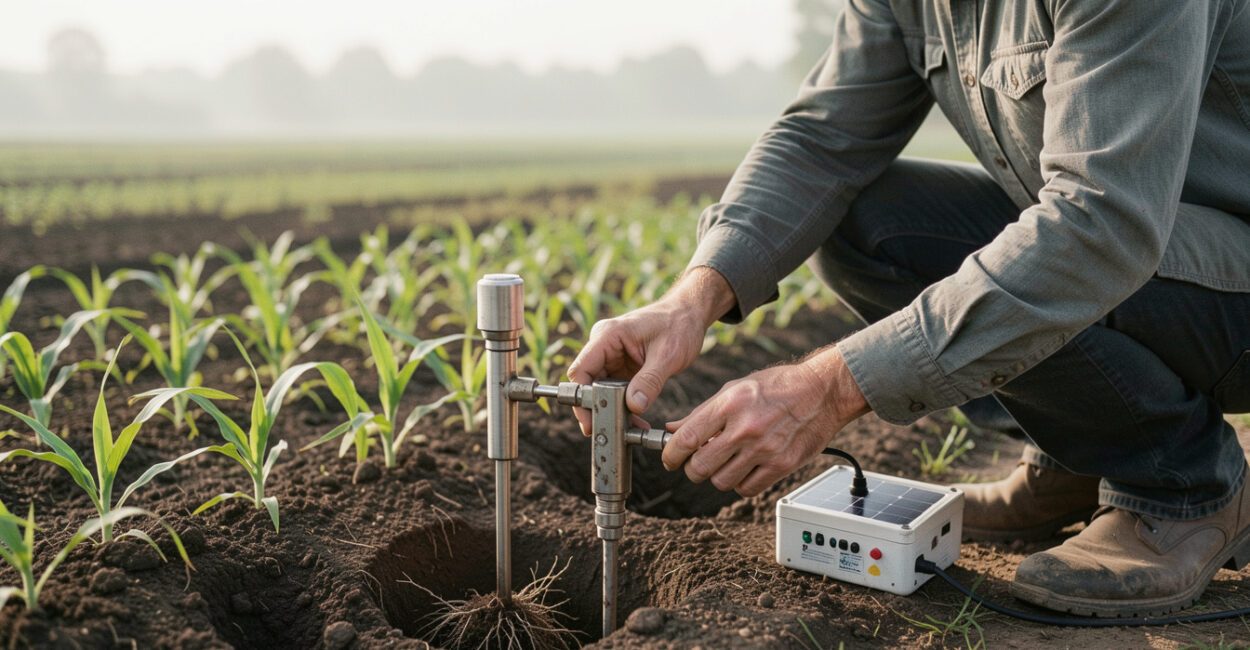
A probe that costs less can become the more expensive choice if it fails after one season or cannot deliver data where you need it. Sensor costs vary with measurement quality, construction, connectivity, and support, so there is no single reliable price for every farm. For a sound comparison, look at the full cost of ownership and the decisions the readings will inform.
For a small operation, a basic sensor may be enough to guide irrigation in a few representative fields. A premium probe can make sense when you need dependable readings across variable soils, remote access, or equipment that will stay installed for years. The right choice depends on how often you’ll use the data and what a wrong reading could cost.
At a Glance
- Compare complete system costs, including gateways, subscriptions, calibration, repairs, and replacement probes.
- For irrigation scheduling, consistent readings at relevant root-zone depths often matter more than a long feature list.
- Budget sensors can suit limited trials, but installation and field checks determine whether their readings are useful.
- Premium probes earn their price when durability, support, or reliable data access reduces meaningful operating risk.
What Determines Agricultural Sensor Costs?
Agricultural sensor cost is the total expense of acquiring, installing, operating, and maintaining a device that measures a field condition, such as soil water content or temperature. Prices depend on what it measures, how it is built, how data are transmitted, and what services come with it. A quote for the probe alone may exclude the hardware and fees required to use its readings.
For a fair comparison, ask vendors to separate the initial probe price from the costs of a gateway, installation, software access, cellular service, calibration, and replacement parts. Also clarify whether pricing covers one sensor or a complete monitoring point. Configurations and regional availability differ, so a price without those details is not a useful benchmark.
Measurement method matters, too. Capacitance and frequency-domain probes estimate water content from the soil’s electrical properties; their performance can depend on soil texture, salinity, and installation. A sensor calibrated for one soil may need field-specific adjustment before its readings support irrigation decisions. The USDA’s Natural Resources Conservation Service provides soil and water conservation resources that can help put field monitoring in context.
Budget Sensors Vs. Premium Probes: What Changes?
| Factor | Budget sensor | Premium probe |
|---|---|---|
| Accuracy and consistency | May be adequate for trends, with greater need for local checks | May offer tighter specifications, documented calibration, or more stable readings |
| Construction | Often suited to temporary tests or protected installations | May use materials and sealing intended for longer field deployment |
| Data access | Could require manual downloads or a basic app | May include remote monitoring, integrations, or alerts |
| Support and upkeep | Limited service options may leave troubleshooting to the buyer | May include technical support, service plans, or replacement pathways |
These are common trade-offs, not guarantees. A premium label does not prove that a probe is more accurate in your soil, and a lower-cost device may perform well for a short trial. Check the stated measurement range, accuracy conditions, calibration approach, warranty, and data-export terms for the exact model and configuration.
The useful comparison is between the readings and service you will actually use, not between price tags alone.

How Accurate Does Your Farm’s Sensor Need to Be?
The required accuracy depends on the decision: a broad wet-versus-dry trend can tolerate more uncertainty than a narrow irrigation threshold. For scheduling, consistency across days and correct placement in the active root zone may be more valuable than an impressive accuracy figure measured under controlled conditions.
Sensor accuracy describes how close a measurement is to a reference value; repeatability describes whether the same sensor gives similar results under the same conditions. Both matter. A probe can produce precise-looking numbers that mislead if it sits in an air gap, a compacted spot, or soil unlike the rest of the management zone.
A common field mistake is treating a single shallow reading as a profile of the whole root zone. In layered soil, water can move past one depth while another remains dry. Place probes at depths that match crop rooting and the decision being made, then compare readings with soil inspection or another trusted measurement before changing irrigation. University of Nebraska–Lincoln Extension offers practical irrigation and crop-water guidance relevant to interpreting field conditions.
There is no universal accuracy threshold that fits every crop, soil, and irrigation system. Soil salinity, texture, temperature, and probe installation can affect readings, so a manufacturer’s specification may not translate directly to field performance.
Data Access and Connectivity: What is Included?
Farm sensor data access can be as consequential as the probe itself. Before buying, confirm whether readings are available through an app, web dashboard, downloadable file, or an application programming interface (API), and whether those options require a recurring subscription.
Connectivity adds costs when a field is beyond reliable Wi-Fi or cellular coverage. A system may need a gateway, a cellular plan, or a different communications network; some devices store readings locally and sync only when a user visits. Ask how often data update, what happens during an outage, and whether you can export your records if you cancel service.
If sensor readings will feed an irrigation platform, verify compatibility before purchase. A closed system may work well on its own but limit integration with other farm software. For broader planning, compare the monitoring workflow with precision irrigation software and its data requirements.
Durability, Calibration, and Maintenance Costs
Sensor durability depends on the probe’s materials, enclosure, cable protection, installation, and exposure to machinery, livestock, moisture, and freeze-thaw cycles. A device intended for seasonal trials may not be designed for years underground. Review the warranty exclusions and ask whether a damaged cable or probe can be repaired separately.
Calibration is the process of checking or adjusting a sensor’s output against a known reference. Some probes arrive with factory calibration; others may need soil-specific calibration or periodic verification. “Maintenance-free” should not be taken to mean “never check it.” Compare the recommended check interval, the procedure, and whether the work requires returning the probe to the manufacturer.
Include labor in maintenance costs. Pulling a probe for inspection, replacing batteries, cleaning contacts, or troubleshooting a dropped connection takes time, even when parts are inexpensive. A device that is difficult to service can cost more over its useful life than its purchase price suggests.
A sensor’s real service life depends on both its construction and the conditions surrounding its installation.
Which Sensor is the Right Fit for a Small Farm?
Start with the management decision, not the product category. If the goal is to test whether soil-moisture monitoring improves irrigation timing in one field, a limited set of lower-cost sensors may be a sensible pilot. If missed readings could lead to repeated crop stress or costly water use, a more durable system with dependable support may be easier to justify.
Match the setup to the variation you need to observe. One probe cannot represent fields with different soil types, slopes, drainage, or irrigation patterns. Begin with a representative management zone, install the sensor carefully, and compare its readings with field observations through changing conditions before expanding the network.
For farms assessing the economics of a larger monitoring setup, review the assumptions in this precision irrigation payback analysis. Its results should be treated as context, not a guaranteed return: water rates, crop value, equipment, and management practices change the calculation.
- Choose a budget model when you need a limited trial and can verify its readings yourself.
- Consider a premium probe when you need long-term installation, remote monitoring, or responsive technical support.
- Delay a purchase if the platform’s recurring fees, coverage, or data-export rules remain unclear.
How to Budget for Sensors and Plan Implementation
Build a cost-of-ownership estimate over the period you expect to use the equipment. Include probes, installation, gateways, connectivity, subscriptions, calibration, repair labor, and likely replacements. Compare that total with the value of the decision the system is meant to improve, such as reducing unnecessary irrigation or catching water stress earlier.
Before ordering, get written answers on these points:
- What is included in the quoted price, and what is billed annually?
- Can you export raw readings and keep access if you end the subscription?
- What accuracy and calibration conditions apply to your soil and installation?
- How are failures handled, and what parts or service are covered by the warranty?
- Can the system expand without replacing the gateway or changing platforms?
Plan a pilot with a clear baseline, a defined monitoring period, and a decision rule: what reading or trend would change an irrigation action? Record installation depth and location, then review data against soil checks and crop conditions. Use a broader smart irrigation implementation plan to connect sensor selection with the rest of the system before scaling up.
What Should I Ask a Supplier Before Buying?
Request the full first-year and renewal costs, the calibration procedure, warranty terms, data-export options, and a description of what happens when connectivity fails. Ask for performance specifications under conditions similar to your soil and installation.
Can a Low-cost Soil Sensor Guide Irrigation?
Yes, if its readings are consistent enough for the decision and you validate its placement and response in the field. Treat an unverified reading as a signal to investigate, not an automatic irrigation command.
Do All Farm Probes Need Annual Calibration?
No. Calibration schedules vary by sensor type and manufacturer. Follow the model’s instructions, and verify readings when they conflict with soil conditions or crop observations.
How Many Probes Should a Small Farm Start With?
Start with enough to represent the management zone you are testing, rather than assuming one probe covers every field. Add locations when differences in soil, drainage, or irrigation practice could change the decision.