
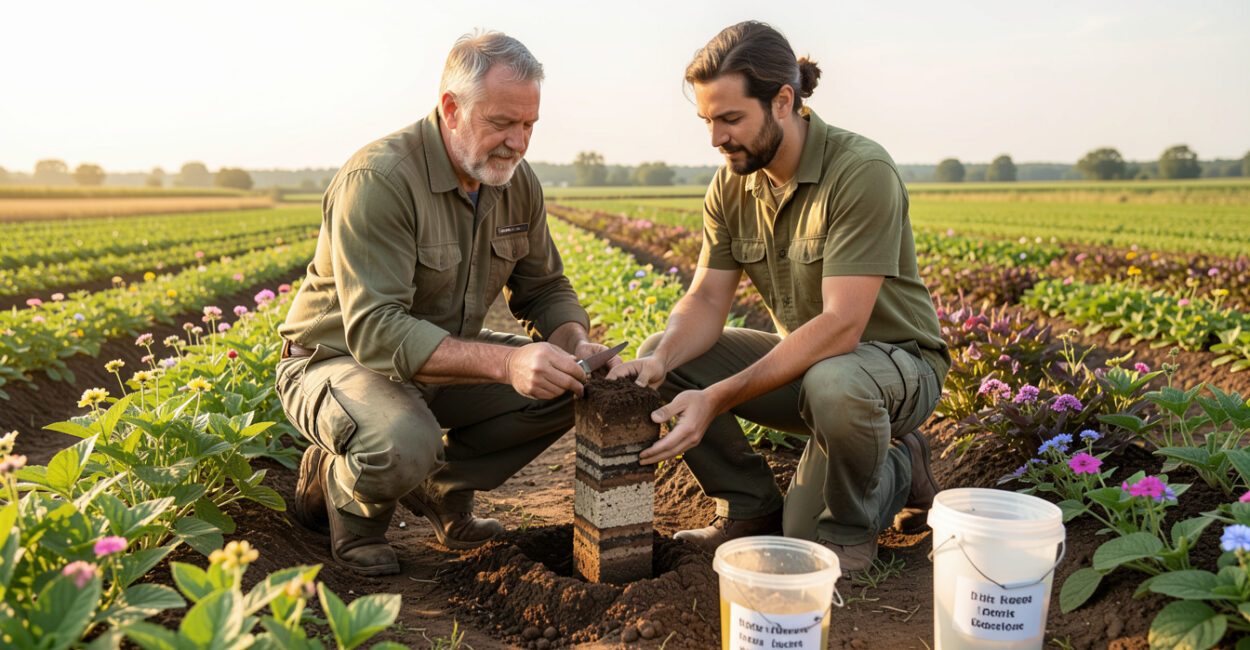
A field can gain soil carbon while producing a crop, but that change does not automatically become a saleable credit. Carbon Credits in Agriculture are issued only when a project follows an accepted method to quantify climate benefits, address risks such as reversal, and complete independent verification. For farmers, the route from new practice to payment often involves years of records and a contract that deserves close reading.
Carbon programs may reward changes in tillage, cover cropping, grazing, tree planting, fertilizer management, or manure handling. Whether a practice qualifies depends on the project rules, the farm’s starting point, and whether the measured reduction or removal is additional to what would have happened anyway.
Think of credit income as contingent revenue, not a guaranteed premium for adopting regenerative practices. Before enrolling, find out who pays monitoring costs, who owns the credits, how long obligations last, and what happens if the carbon benefit is smaller than expected.
Key Takeaways
- A carbon credit generally represents one metric ton of carbon dioxide equivalent reduced or removed, issued under a defined program after accounting and verification.
- Farm practices can contribute to carbon storage or emissions reduction, but a practice alone does not guarantee credit issuance.
- Soil-carbon estimates carry uncertainty because results vary across fields, seasons, soil types, and measurement methods.
- Farmers should compare net payment, data access, land-use restrictions, reversal liability, and contract length, not just the stated price per credit.
What Carbon Credits in Agriculture Represent
An agricultural carbon credit is a serialized unit issued under a carbon program for a quantified and verified reduction in greenhouse gas emissions or removal of carbon dioxide from the atmosphere, commonly expressed as one metric ton of carbon dioxide equivalent. A farm may generate eligible benefits through changed management, but the credit exists only after the project meets the program’s accounting and issuance rules.
This is different from reducing a farm’s own emissions. Using less diesel or improving fertilizer efficiency may lower the farm’s footprint; a credit is a separate, tracked unit that can be sold or retired by a buyer to compensate for emissions elsewhere. The distinction matters: a farm can cut its emissions without generating credits, and a credit purchase does not erase the farm’s own emissions.
Program rules define which activities count and how outcomes are calculated. For example, Verra’s VM0042 methodology for improved agricultural land management sets requirements for quantifying relevant changes in agricultural emissions and soil organic carbon.
Which Farm Practices May Generate Credits?
Eligibility depends on the methodology and the project’s boundary. The same practice may qualify on one farm and fail to qualify on another if baseline conditions, documentation, or expected climate effects differ.
- Soil-carbon practices: Cover crops, reduced or no-till systems, diversified rotations, and improved grazing management may increase soil organic carbon or reduce emissions. Soil carbon can vary sharply within a field, so a program needs a credible sampling or modeling approach.
- Agroforestry: Integrating trees with crops or livestock can store carbon in woody biomass and, in some cases, soils. Long time horizons, land tenure, tree survival, and the risk of later clearing all affect project design.
- Methane reduction: Changes to manure storage or handling, livestock feeding, and other practices may reduce methane emissions where a recognized method can quantify the change. Livestock projects need to distinguish a measured emissions reduction from general claims about improved sustainability.
- Nutrient management: Better timing, placement, or rates of nitrogen fertilizer may lower nitrous oxide emissions. The project must account for relevant inputs and conditions rather than assume that any fertilizer reduction produces a credit.
Practices often have agronomic value beyond carbon, but their effects are not interchangeable. A farmer considering regenerative agriculture practices should first assess soil, water, labor, and yield trade-offs, then check whether a program recognizes the specific change.
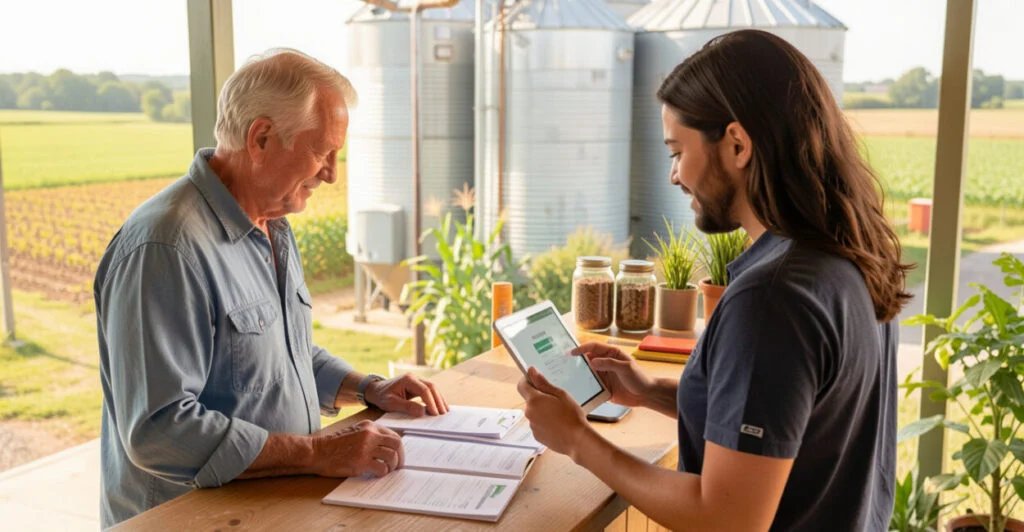
How an Agricultural Carbon Project Moves from Practice to Sale
A typical project proceeds through enrollment, baseline assessment, practice implementation, monitoring, independent verification, credit issuance, and sale or retirement. Each stage has its own costs and timing, so signing up does not mean the farmer has already earned a credit.
- Check eligibility and enroll. The project developer defines the eligible land, practices, start date, and participant obligations. Ask whether the program accepts existing records and what happens to fields that leave the project.
- Establish a baseline. The project documents prior management and estimates what emissions or carbon stocks would have been without the intervention. This counterfactual is central to determining whether the benefit is additional.
- Implement and document changes. Keep dated records of field operations, inputs, crop rotations, grazing, yields, and other data required by the method. In practice, a missed field-operation date or incomplete input record can create more trouble at verification than the practice itself.
- Monitor and verify. The project compiles measurements and calculations; an independent verifier checks whether they meet the program’s rules.
- Issue and sell credits. The registry issues credits after approval. The project developer or another party then arranges a sale, with the farmer receiving the share set out in the contract.
Payments may come only after verification and sale, or a program may offer advances or other payment schedules. A farm should not assume a fixed payment date: enrollment, monitoring periods, verification queues, buyer demand, and contract terms all affect when money arrives. For a wider look at funding structures, see these climate finance options for agribusiness.
How Carbon is Measured and Verified
Monitoring, reporting, and verification (MRV) is the system used to track project activities, calculate climate outcomes, document the results, and have them checked against a methodology. Depending on the project, MRV may combine farm records, soil sampling, remote sensing, activity data, and models.
Soil-carbon measurement is particularly challenging. Carbon is unevenly distributed, samples represent only specific places and depths, and changes can be small relative to natural variation. A model can estimate change across a larger area, but its output depends on input data and assumptions; sampling can provide direct evidence while still missing field-level variation.
The IPCC 2019 Refinement to the 2006 Guidelines for National Greenhouse Gas Inventories provides methods for estimating land-sector emissions and removals. Project methodologies apply defined accounting rules to a particular crediting context; they do not remove measurement uncertainty from the underlying agricultural system.
Farmers should ask who owns raw farm data, who can access it, how long it is retained, and whether the project shares identifiable information with buyers or other parties. They should also ask how uncertainty is handled, including whether credits are discounted, pooled, or held in a buffer against reversals.
What Makes an Agricultural Credit Credible?
Credibility depends on whether the reported climate benefit is real, attributable to the project, durable enough for the claim, and counted only once. Program registration and third-party verification help enforce rules, but neither makes every project outcome certain.
- Additionality: The credited change must go beyond what would likely have happened without the project. Farmers already using a practice may still qualify in some programs if the method allows a defensible case that the project caused an additional change, but routine continuation alone may not pass the test.
- Permanence: Stored carbon can be released by tillage changes, fire, drought, land conversion, or other disturbances. Contracts and program rules may address this through monitoring, replacement obligations, or buffer reserves, each of which can affect the farmer’s share.
- Leakage: A project can shift emissions outside its boundary. For example, restricting production on enrolled land could move production to another location, so the project may need to account for that displacement.
- Double counting: The same climate benefit should not be issued or claimed more than once. Credit serial numbers, registry records, ownership terms, and retirement records help establish who holds and uses a unit.
Gold Standard’s methodology and framework documents include approaches for soil organic carbon accounting. Read the specific method and version used by a project; a general claim that a program follows a recognized standard is not enough to evaluate its accounting choices.
Costs, Payments, and Trade-Offs for Farmers
Net income depends on the quantity of credits issued, the sale price, the project’s fees, and the farmer’s contractual share. It can also be affected by verification costs, withheld buffer credits, buyer demand, and whether the project pays before or after credits sell. Treat gross estimates as projections until the contract explains how each deduction and risk works.
Project model
Potential benefit
Trade-offs and commitments
Developer-led, pooled project
Can spread measurement and verification costs across many farms.
Farmers may have less control over project design, data use, credit sales, and payment timing.
Farm-specific project
Can tailor the baseline and monitoring plan to the operation.
Sampling, documentation, and verification costs may be harder to support at smaller scale.
Insetting or supply-chain program
May connect farm practices with a buyer’s agricultural supply chain and support other farm goals.
Benefits may be paid as incentives rather than registry credits, and claims or ownership may be limited to the supply-chain agreement.
Small farms can participate, often through aggregators that combine acreage and share MRV costs. The trade-off is that a pooled program may require standardized records and offer less flexibility. A farmer with a small acreage should compare expected net payment and time burden, not just the advertised per-acre or per-credit figure.
Who owns the credits depends on the contract, applicable program rules, and land or operating rights. A landowner, tenant, project developer, or buyer may hold different rights; clarify who can register, transfer, sell, and retire credits before signing.
How to Assess a Carbon Program Before Signing
Use the contract and methodology together: the contract explains your obligations and payment rights, while the methodology explains how the project quantifies climate outcomes. If those documents do not align, pause before enrolling.
- Eligibility: Which fields and practices qualify? Can practices already in use earn credits, and what evidence is needed to show additionality?
- Money: How is the farmer’s share calculated? Who pays for sampling, verification, registry fees, and project administration? Is payment based on issued credits, sold credits, or another formula?
- Duration and exit: How long does the commitment last? Can the farmer leave, sell or lease land, change practices, or respond to crop failure without triggering repayment or penalties?
- Reversal and shortfalls: Who bears the cost if carbon is lost or a project falls short? Is there a buffer, replacement duty, or liability that could extend beyond the contract term?
- Data and claims: Who can use farm data, and can the farmer obtain a copy? What exactly may the buyer claim, and will the credits be listed and retired in a registry?
A useful decision rule: if a farm cannot meet the recordkeeping burden without disrupting operations, or if the agreement leaves reversal liability and credit ownership unclear, the program may not be worth joining even if its headline payment looks attractive. Keep the signed contract, methodology version, field records, and all payment statements together.
Before enrollment, choose one representative field and ask the program to walk through the baseline, required records, estimated deductions, and payment trigger for that field. Then compare the written answers with the contract and methodology, and review related climate adaptation options that may deliver value even without credit revenue.
📱 See this content as a Web Story
Frequently Asked Questions
How Long Does It Take for a Farm to Receive Payment?
There is no universal timeline. Payment may wait until monitoring is complete, a verifier approves the project, credits are issued, and a buyer pays, unless the contract specifies advances or another schedule.
Can a Farm Earn Credits for Practices It Already Uses?
Sometimes, but existing practice alone does not establish additionality. Ask the program whether its method accepts that history and what evidence it requires to show a creditable change.
Can a Farmer Participate Without Giving a Buyer Ownership of the Credits?
Possibly, but the project agreement may assign credit rights to a developer or buyer in return for project services or payment. Read the clauses on title, transfer, retirement, and environmental claims rather than relying on informal descriptions.
Are All Soil Carbon Credits Measured with Soil Samples?
No. Programs may use sampling, models, activity data, remote sensing, or a combination. The method should explain how it handles uncertainty and how measurement results affect the number of credits issued.
What Happens If Stored Carbon is Later Released?
Consequences depend on the program and contract. A project may use buffer credits, require replacement, or impose other duties, so farmers should identify who carries that liability and how long it can last.