
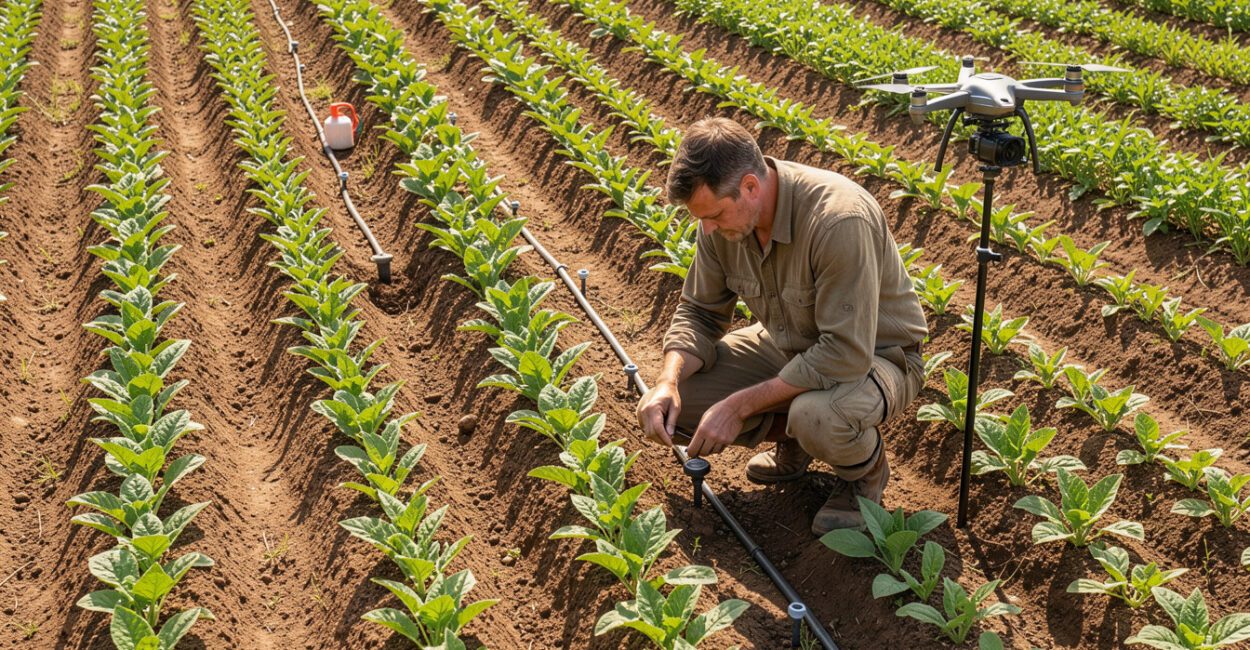
A field sensor can report dry soil, but it cannot tell a grower whether a clogged emitter, a passing storm, or a faulty probe explains the reading. Artificial Intelligence (AI) can help interpret that data and suggest a response, yet the recommendation still depends on what the system was trained to recognize.
AI now appears in everyday software, business operations, research, and agriculture. Understanding what it can do, how it reaches an answer, and where it can fail makes it easier to use the technology without mistaking a convincing output for a verified fact.
For farmers, the most useful applications tend to support a specific decision: where to scout, when to irrigate, or which equipment needs attention. The same principles apply beyond agriculture, from email filters to medical image analysis.
What is Artificial Intelligence, and How is It Different from Automation?
Artificial Intelligence is a field of computing that develops systems able to perform tasks associated with human capabilities, such as recognizing patterns, making predictions, understanding language, or generating content. In plain terms, an AI system uses data and a method for processing it to produce an output that can inform or automate a task.
Automation follows rules set in advance. A timer that turns on irrigation at 6 a.m. is automated; a system that uses soil readings and weather forecasts to recommend a watering time may use AI. The distinction depends on how the system reaches its output, not on whether it runs without a person pressing a button.
Machine learning is one approach within AI: a model learns patterns from examples instead of relying only on hand-written rules. Deep learning is a type of machine learning that uses layered neural networks to process complex patterns, such as those in images or speech. Generative AI uses learned patterns to create new content, including text, images, audio, or code.
Those terms describe related but different things. A crop disease image classifier may use deep learning without generating anything; a chatbot may use generative AI and machine learning. Neither example proves the system understands a crop or conversation as a person would.
How Does AI Work from Data to a Recommendation?
Most AI systems use data to fit a model, then apply that model to new inputs during inference. The result may be a classification, prediction, recommendation, or generated response; its quality depends on the data, model design, and conditions in which it is used.
- Collect inputs: Data may include labeled crop images, equipment records, weather observations, or text. Missing or inconsistent records can limit what the system learns.
- Train a model: A learning algorithm adjusts the model to capture patterns in examples. Developers test it on data held apart from training to check how well it handles cases it has not seen.
- Run inference: The trained model processes new inputs, such as a current sensor reading, and returns an output.
- Review and act: A person or another system decides whether the output is appropriate. Feedback and new data may help improve later versions, but they do not automatically fix every error.
For example, a model trained on images of a particular crop disease may flag similar-looking leaves in a new photo. If the photo is blurry, the variety is unfamiliar, or the lighting differs from its training images, the result may be wrong. A grower should treat the flag as a reason to inspect, not as a diagnosis by itself.
In irrigation, a recommendation is only as useful as its inputs. Sensor depth, soil type, calibration, and placement affect what a reading means; guidance on calibrating moisture sensors helps explain why raw numbers can mislead.
An AI recommendation is only as dependable as the data, testing, and human judgment behind it.

What Types of AI Exist, and Which Ones Are in Use?
Most AI in use today is narrow AI: a system designed for a defined task or a limited set of tasks. It can be highly capable in its intended setting without having the broad, flexible abilities associated with human intelligence.
People sometimes describe AI as narrow, general, or superintelligent. Artificial general intelligence (AGI) refers to a hypothetical system with broad abilities across many domains; superintelligence describes a still more speculative capability. Neither is an ordinary, established feature of current commercial AI systems.
It helps to classify tools by what they do:
- Predictive systems estimate outcomes, such as equipment failure risk or likely demand.
- Perception systems interpret inputs such as images, sound, or sensor signals.
- Generative systems produce content from prompts and learned patterns.
A single product may combine these methods. The label “AI-powered” alone does not tell you which one it uses, what data it needs, or how much human review its outputs require.
Where is AI Used in Everyday Life, Business, and Agriculture?
AI applications range from small conveniences to decision-support systems. The common thread is that software uses patterns in data to produce an output that would otherwise require a person’s attention or a set of explicit rules.
People encounter it in email spam filters, map route suggestions, speech recognition, and product recommendations. At work, it can help sort documents, summarize material, flag unusual transactions, or draft content. In healthcare, some systems assist with tasks such as analyzing medical images; clinicians remain responsible for interpreting results in context.
In education, AI can help generate practice questions or adapt explanations, but a student still needs reliable instruction and feedback. Researchers use machine-learning methods to search large datasets and identify patterns that can guide further investigation. In every setting, performance can vary with the task, data, and consequences of an error.
On a farm, image analysis can help prioritize which areas to scout, while sensor data and weather information can support irrigation planning. A reliable setup still requires attention to sensor placement and field conditions; choosing where to install soil probes affects whether readings represent the root zone being managed.
AI is a poor fit when the task is already simple, the data is unreliable, or no one can check the output. A fixed schedule may be preferable to a complex prediction system if the schedule is adequate and the cost of added equipment, connectivity, and maintenance outweighs any likely benefit.
What Benefits and Limitations Should Users Weigh?
AI can help process large volumes of information, spot patterns, and reduce repetitive work, but those gains depend on whether its outputs are accurate enough for the task and worth the cost of using them.
Consideration Potential benefit and limitation Accuracy Can detect patterns in suitable data; performance may fall when real conditions differ from training data. Time and cost Can speed up routine work; setup, subscriptions, data preparation, connectivity, and maintenance add costs. Privacy Can process information at scale; data collection and retention may expose personal or business details. Human oversight Can help people prioritize decisions; a person must still review outputs when mistakes carry meaningful consequences.
For an irrigation tool, compare its recommendation with the cost of a wrong call. A false “water now” alert may waste water; a missed alert during a sensitive growth stage may harm a crop. Before buying, check what inputs the system needs, whether those inputs are already available, and how the recommendation can be verified. A practical overview of interpreting soil-moisture readings can help establish that baseline.
The NIST AI Risk Management Framework offers a voluntary structure for identifying and managing AI risks. Its emphasis on context matters: an acceptable error rate for sorting low-priority messages may be unacceptable for a safety-critical decision.
Why Can AI Give Incorrect or Biased Answers, and Will It Replace Jobs?
AI can produce incorrect or biased outputs when its training data is incomplete, unbalanced, outdated, or poorly matched to the situation where it is used. A generative model may also produce fluent text that is unsupported, because it generates likely sequences rather than checking every claim against a trusted source.
Bias can enter through historical records, uneven representation, or the way a task is defined. A crop-monitoring model trained mostly on images from one region may perform less well under different lighting, soil backgrounds, or crop varieties. Testing should therefore include conditions and groups likely to be affected, not only the examples that were easiest to collect.
Can AI Think or Understand Like a Human?
Current AI can perform tasks that look intelligent, but that does not establish human-like understanding, awareness, or judgment. A system can produce a plausible explanation while missing context that a person would notice.
Will AI Replace Human Jobs?
AI is more likely to change particular tasks than to replace every job that includes them, and the effects vary by occupation and workplace. It may take over routine steps, create demand for new oversight work, or change how teams are organized; no general prediction can reliably describe every worker’s outcome.
The OECD AI Principles frame trustworthy AI around human-centered values, transparency, and accountability. These principles are useful because responsibility cannot be assigned to a model alone: organizations choose how to deploy it, and people decide how to act on its output.
How Can People Use AI Responsibly?
Use AI as a decision aid, match review to the stakes, and avoid sharing data unless you understand how the service handles it. A text draft may need a quick fact-check; a recommendation affecting health, finances, safety, or a crop may require expert review and independent evidence.
- Verify important claims: Check names, figures, citations, and recommendations against primary sources or qualified professionals.
- Protect sensitive information: Do not enter passwords, financial account details, confidential business records, private health information, or identifying details unless the tool is approved for that data and its terms are understood.
- Keep a person accountable: Decide who reviews outputs, who can override them, and what happens when the system is uncertain or unavailable.
- Disclose AI use when it matters: Follow workplace, school, legal, or publication rules, especially when readers need to know how content or decisions were produced.
On a farm, start with a low-risk decision and compare the tool’s advice with field observations over time. If recommendations rely on sensor data, confirm that probes are installed, calibrated, and maintained correctly; software cannot repair a poor measurement.
Key Questions About Artificial Intelligence, Answered
Question Short answer What does AI mean? Computing systems that perform tasks such as pattern recognition, prediction, language processing, or content generation. Is AI the same as machine learning? No. Machine learning is one approach used within the broader field of AI. How does AI work? A model learns from data and applies learned patterns to new inputs during inference. Can AI be wrong or biased? Yes. Data gaps, poor fit, and deployment conditions can lead to inaccurate or unfair outputs. How should people use it? Protect sensitive data, verify consequential outputs, and keep human oversight in place.
For a first step, choose one recurring task, define what a useful result would look like, and check whether the required data is trustworthy. Then compare the tool’s output with a human-reviewed baseline before relying on it for decisions with real consequences.
📱 See this content as a Web Story
Frequently Asked Questions
What is the Difference Between a Chatbot and a Search Engine?
A search engine typically retrieves and ranks existing pages. A chatbot generates a response from its model and, in some cases, information retrieved from other sources; its answer still needs checking.
Does AI Always Need an Internet Connection?
No. Some systems run on local devices or on-site computers, while others depend on remote servers. The right setup depends on the model, hardware, privacy requirements, and whether a connection is available.
Can AI Make Decisions Without Human Input?
Some systems can trigger actions automatically within limits set by their developers or operators. For high-impact decisions, organizations should define oversight, escalation, and appeal processes rather than treating automated output as unchallengeable.
How Can a Business Tell Whether an AI Tool is Worth the Cost?
Compare its full operating cost with a clear baseline: time spent, error rates, and the consequences of mistakes. Include setup, training, data preparation, integration, and ongoing review, not only the subscription price.
What Should Be Checked Before Using AI-Generated Information in a Report?
Verify factual claims with reliable sources, confirm that citations point to real material, and follow the organization’s disclosure and data-handling rules. Generated wording can sound authoritative even when its supporting evidence is weak.