
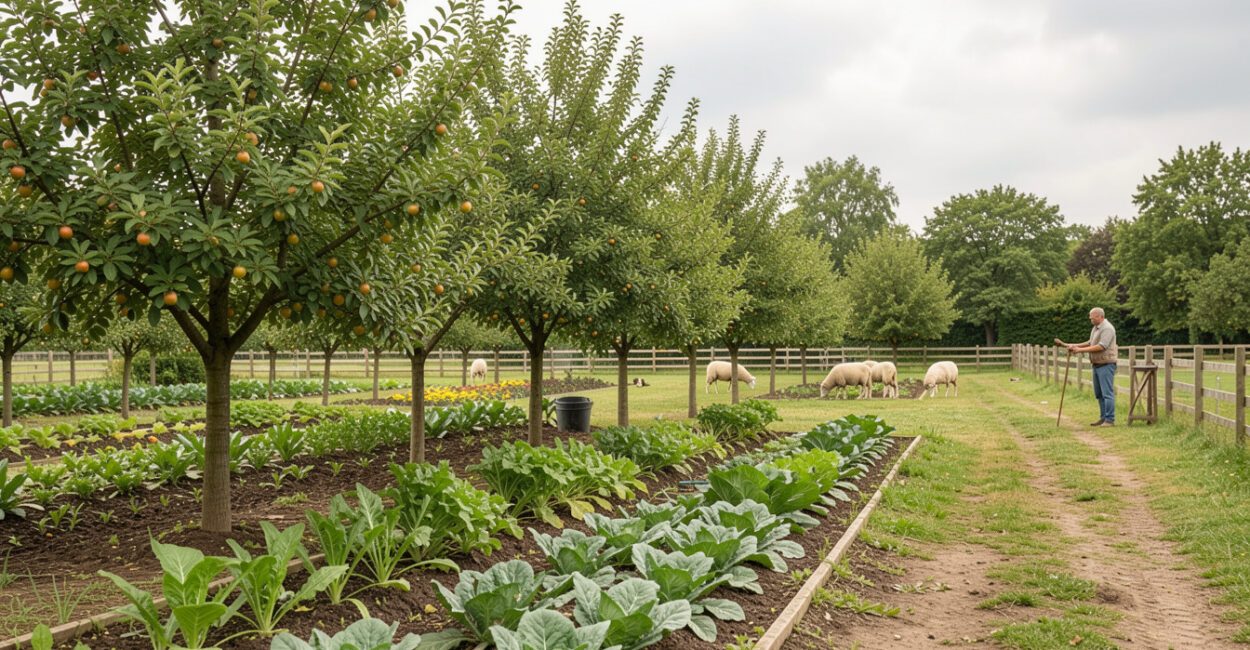
A tree row can protect a field from wind and still compete with crops for light and water. That tension is why an agroforestry plan needs to fit the farm, not just look good on paper. Agroforestry Systems integrate trees or shrubs with crops, livestock, or both on the same land. The right design depends on what the land manager wants to produce and what the site can support.
Farmers often consider these practices to diversify production, protect soil, or improve resilience to weather. None of those outcomes is automatic: species, spacing, management, and local conditions all matter. A system that suits a grazed pasture may be a poor fit for a field where machinery needs wide, clear passes.
The phrase can also refer to Agroforestry Systems, a scientific journal. This article uses it to mean land-use practices that deliberately combine woody plants with agriculture.
What Agroforestry Systems Are, and What They Require
Agroforestry is the intentional integration of trees or shrubs with crops, livestock, or both, on the same land-management unit. The plants and farm enterprises interact over time, so the design accounts for their effects on light, water, soil, access, and production. Planting trees alone does not make a farm an agroforestry system; the trees need a planned role within the operation.
That role might be producing timber or fruit, sheltering livestock, reducing wind exposure, or supplying specialty crops beneath a forest canopy. The USDA National Agroforestry Center describes practices such as alley cropping, silvopasture, windbreaks, riparian forest buffers, and forest farming. Each has a different layout and management purpose.
Why Tree–Crop and Tree–Livestock Combinations Can Fail
Competition is a common cause of underperformance. Trees can shade crops, draw water from nearby soil, and occupy space that machinery or livestock need. The effects vary by species, age, climate, soil, and distance between plants, so spacing that works on one farm may disappoint on another.
Timing matters, too. A young planting may need years of protection and care before it produces a saleable crop or meaningful shelter. Meanwhile, livestock can browse seedlings, weeds can overtake them, and missed mowing or pruning can make maintenance harder later. A practical detail that is easy to overlook: tree guards must be checked after animals enter a paddock, because a damaged guard can expose a seedling to repeated browsing.
Start by naming the farm problem the trees are meant to address. If the main goal is shade for livestock, a silvopasture layout may deserve a closer look. If wind damage is the concern, a windbreak may be a more targeted choice than planting trees throughout the field. For broader planning around climate exposure, see these climate adaptation strategies for local agribusinesses.
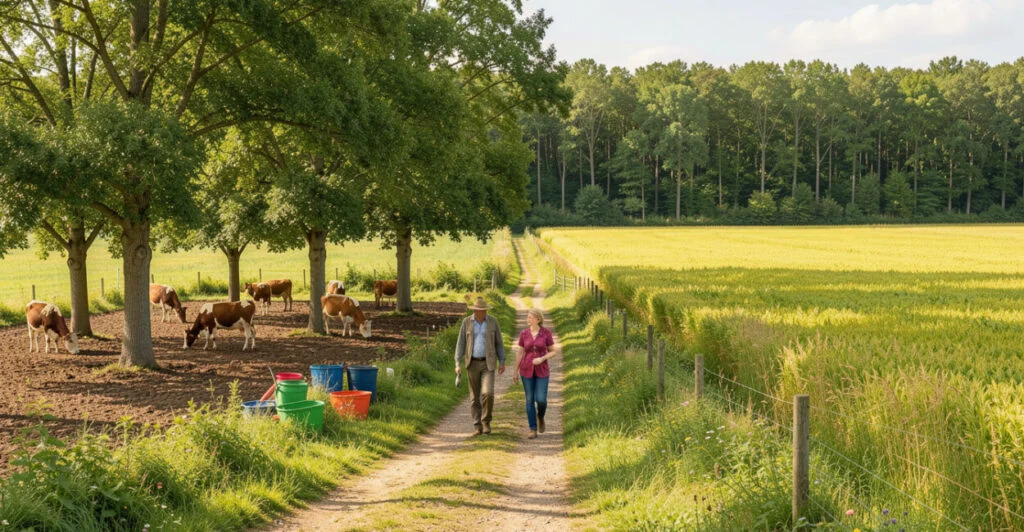
How to Compare the Main Agroforestry Practices
These practices differ in where trees go, what they produce, and how they affect daily farm operations. Use the comparison to narrow options, then check the fit against local conditions and the farm’s production calendar.
Practice Basic layout Possible fit Key trade-off Alley cropping Rows of trees or shrubs with crops grown in the alleys between them Fields where crop production and a woody product can share space Shade, roots, and row spacing can affect crops and machinery access Silvopasture Trees or shrubs integrated with pasture and livestock Grazing operations seeking a planned tree-and-forage layout Young trees need protection; tree cover can change forage growth Windbreaks Rows of woody plants placed to reduce wind exposure Fields, livestock areas, or farm infrastructure exposed to wind Placement and maintenance affect the area protected and access Forest farming High-value crops grown beneath a managed forest canopy Wooded land with suitable understory conditions and a market Returns depend on crop suitability, harvest access, and sales channels
A riparian forest buffer is another distinct practice: trees and other vegetation are managed beside a stream or other waterway. The USDA National Agroforestry Center’s practice resources can help land managers compare these approaches. For a wider look at soil-focused farm management, read about regenerative agriculture and soil restoration.
What Benefits and Trade-Offs Should You Weigh?
Agroforestry benefits can include additional products, reduced wind exposure, habitat, and changes to soil or water conditions. Whether a particular benefit appears, and how much it matters, depends on design and local conditions. Trees also require land, labor, time, and often upfront investment.
Revenue can come from crops, nuts, fruit, timber, forage, or other products, depending on the system and the farm’s markets. Some practices may also contribute to climate goals, but carbon storage is not guaranteed or easy to quantify on every site. Avoid treating projected carbon income as a sure return; eligibility and measurement rules depend on the program.
Costs may include seedlings, site preparation, fencing, guards, irrigation, pruning, and the value of land or crop production displaced during establishment. For a financial plan, separate near-term expenses from uncertain future income. A farm considering environmental revenue can review how agricultural carbon credit programs work, while checking the requirements of any specific program before counting on payments.
How to Choose a System for a Particular Site
Choose tree and crop or livestock combinations by matching a clear farm objective to site conditions, operational needs, and a credible market. Start with the constraint that could make the planting fail, such as limited water, difficult equipment access, or livestock browsing, rather than choosing species from a generic list.
- Set the goal: Decide whether the priority is a marketable product, shelter, soil protection, livestock comfort, or another defined purpose.
- Assess the site: Review climate, soil drainage and depth, slope, water availability, existing vegetation, and exposure to wind or frost.
- Check the operation: Map equipment routes, grazing rotations, fencing, labor availability, and the space needed for future maintenance.
- Test the market: Identify buyers, quality requirements, processing or storage needs, and the time between planting and sale.
- Compare the risks: Consider crop shade, root competition, drought, pests, fire, and the cost of protecting young plants.
Small farms can use agroforestry, too. A narrow windbreak, a few well-placed trees in pasture, or a small forest-farming area may be more manageable than converting a large acreage. Scale the planting to available labor and budget, and leave room to adapt if the first design does not perform as expected.
Before choosing species, consult local extension staff, a forester, an agroforestry specialist, or a conservation planner familiar with the region. The FAO guide to advancing agroforestry on the policy agenda provides broader context on planning and support, but local advice is needed for species, spacing, and site-specific recommendations.
How Long Can Agroforestry Take to Pay?
Economic returns may begin within a few years or take much longer, depending on the products, species, establishment costs, and market access. Annual crops or forage may provide income sooner than timber, while fruit and specialty crops follow their own production timelines. No single payback period applies to all farms.
Build a cash-flow timeline before planting. List establishment and maintenance costs by year, note when each product could become saleable, and use conservative assumptions for yield, price, and losses. If the plan depends on a future market, secure buyer information before investing; projected demand is not the same as a confirmed outlet.
Some farms may need financing to cover establishment costs before returns arrive. Compare funding terms and eligibility carefully, and consider whether the farm can carry the investment through a delayed harvest. This overview of climate finance options for agribusiness may help frame that discussion.
How to Plan, Establish, and Manage a Planting
Begin with a map of the proposed area, including slopes, water features, field edges, utilities, access routes, and existing trees. Mark where equipment turns, livestock move, and water flows. A design that ignores those everyday patterns can create recurring workarounds.
Choose species suited to the region and intended products, then confirm planting stock and local regulations with qualified advisers. Plan spacing and orientation around the system’s purpose, and decide in advance how you will protect seedlings, control competing vegetation, replace losses, prune, and manage livestock access. The right details vary by species and site; regional guidance should take precedence over generic spacing advice.
For a first project, a small trial area can reveal whether the design fits the farm’s labor, equipment, and management capacity. Track survival, growth, crop or forage performance, maintenance time, and costs. Those records can guide adjustments before expanding.
📱 See this content as a Web Story
Frequently Asked Questions
Can Trees and Crops Share the Same Field Without Reducing Crop Production?
Sometimes, but not in every layout or at every stage of tree growth. Shading and root competition can reduce crop performance, so spacing, species, field orientation, and crop selection need to fit the site.
Should a Farmer Plant Trees Before Finding a Buyer?
For a system that depends on selling a tree-based product, identify likely buyers and market requirements before planting. A product with no practical route to market can turn a biological success into a financial disappointment.
What Should a Land Manager Bring to an Agroforestry Adviser?
Bring a property map, soil and water information if available, a description of current production, equipment and grazing plans, labor capacity, and the project’s main goal. A preliminary budget and any potential buyer information help the adviser assess whether the proposed system fits the operation.